


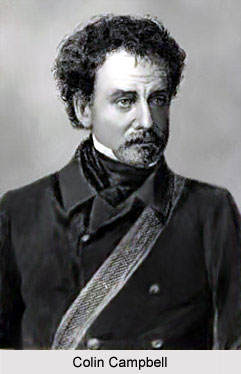
 Eastern Bengal and Eastern Bihar was comparatively better than North West India in 1857. When Sir Colin Campbell had started for Allahabad and Kanhpur (Kanpur) to carry out great military measures in the North-west Provinces he was well aware that he had left behind him many districts smouldering with revolt. Allahabad, Kanpur, Lucknow, Agra and Punjab had already been restored and recovered triumphantly. Sir Colin Campbell was a man of astute genius and he had been clever enough to convince Lord Canning of the method he would apply to recover these boiling places. After much despatch of troops and battalion under competent officers and bloodbath, he reigned supreme in the states. However, there were others in which rebellion was raising its head, and which would require sharp measures of repression. Eastern Bengal and Eastern Bihar was comparatively better than North West India in 1857. When Sir Colin Campbell had started for Allahabad and Kanhpur (Kanpur) to carry out great military measures in the North-west Provinces he was well aware that he had left behind him many districts smouldering with revolt. Allahabad, Kanpur, Lucknow, Agra and Punjab had already been restored and recovered triumphantly. Sir Colin Campbell was a man of astute genius and he had been clever enough to convince Lord Canning of the method he would apply to recover these boiling places. After much despatch of troops and battalion under competent officers and bloodbath, he reigned supreme in the states. However, there were others in which rebellion was raising its head, and which would require sharp measures of repression.
Eastern Bihar was presided over by a gentleman of marked energy of character, George Yule. There had been no outbreak on the part of the two sipahi regiments located there-one, the 63rd, at Barhampur, the other, the 32nd, at Bansi. Some men of the 5th Irregular Cavalry, stationed at Rohni, had indeed made a dishonest attempt to murder their officers. But their commandant, Major Macdonald, had frustrated their attempt. He had displayed an energy and promptness of action which had wholly dominated the restless spirits of the disaffected. Yule, ever watchful, had, with the aid of a small party of Europeans, maintained order in his division. But when Western Bihar, sympathising with the revolted sipahis of Danapur, rose, he deemed it wise to secure the important posts of Bhagalpur and Munger. These were the posts necessary to assure the free navigation of the Ganga River. These places secured, he could hear with comparative indifference of the rising of the 5th Irregulars, on 14th of August. The indifference was more because the men of that regiment failed to provoke either of the two native regiments in his division to join them. Yule's position, however, was full of peril. Those regiments were not to be depended upon. Yule was exposed to the inroad of mutineers from Chota Nagpur on the one side and from Eastern Bengal on the other. Chota Nagpur is a mountainous district lying between Southern Bihar, Western Bengal, Orissa, and the Central Provinces. It is inhabited by aboriginal tribes, and possessed four principal military stations, Hazaribagh, Ranchi, Chaibasa, and Purulia. The troops stationed there were a detachment of the 8th N.I. and the local Ramgarh battalion, composed of horse, foot, and artillery. The Commissioner was Captain Dalton, a man of energy and ability. The district's difficulties commenced when the native troops of Danapur were allowed to rise in revolt. From that time to the very close of the rebellion, it remained a rotting sore in the heart of the country. The mutineers harassed the neighbouring district, and interrupted communications along the grand trunk road. Major English of the 53rd, despatched by Sir Colin Campbell to deal with them, inflicted a great defeat on their main body at Chatra, on 2nd October. Thus he was successful to temporarily relieve the grand trunk road. English was however compelled to march north-westwards. Rattray, with his Sikhs, replaced him, and maintained in the most prominent posts a rough kind of order. But the danger was not altogether averted until the repression of Kunwar Singh and his brothers. In Eastern Bengal there had been, first, manifestations, then outbreaks. These were quite sufficient to cause considerable alarm. On 18th November, the sipahis (soldiers) stationed at Chitragaon, had made itself obvious for its disloyalty at Barrackpur as the 34th N.I., revolted. The band released the prisoners from the jail and quitted the station, carrying with them the contents of the treasury, and three elephants. They made for Hill Tiparah, avoiding British territory. They were of the hope thus to reach their homes. Four days later the authorities at Dhaka (now in Bangladesh) attempted to disarm the 350 sipahis stationed there. The attempt failed for the sipahis resisted. Although in the contest which followed they were beaten, yet, as at Danapur, the majority got off with their muskets. The rebels started for Jalpaiguri, where was located the headquarters of their regiment, the 73rd. The Government of India had been alive to the magnitude of taking measures to provide against the consequences of an outbreak in Eastern Bengal. The natural run of successful revolters would, they knew, be for the important stations at Purnia, Dinajpur, and Rangpur. These places were thoroughly the gateway for the states of Eastern Bengal and Eastern Bihar. To avert the danger from these, Halliday had obtained the sanction of the Government of India to enlist bodies of sailors. They then were lying idle in Calcutta, and were ordered to serve as garrisons in those and other places. The precaution was not taken an hour too soon. But it was taken in time. By means of it, and of the gallant and loyal conduct of the Silhat Light Infantry, led by Byng and after him by Sherer, the rebels from Chitragaon were intercepted and destroyed. Those from Dhaka were, in a certain sense, more fortunate. Bewildered by Halliday's precautions in their original intentions, they apparently decided to make for Jalpaiguri. Their primary intention was to effect there a junction with the main body of their regiment, the 73rd. That regiment had been kept from outbreak by two circumstances. Firstly, that they were located in an isolated station, cut off from their comrades, and they had but a vague perception of what was passing in the world beyond them. Secondly, by the splendid firmness of their commanding officer, Colonel George Sherer, who, on the first symptoms of mutiny had seized the ringleaders, and brought them to a court-martial. In pursuit of the sentence recorded, he had them blown away from guns, despite the order of the cowed authorities in Calcutta that Sherer should release them. The execution of those three rebels had saved many hundreds of lives, and had helped to maintain order. But not even the conceited bearing of Sherer would have kept his men to their allegiance, had their mutinied comrades reached Jalpaiguri. It became, then, a great object to prevent them, and this task was entrusted to the capable hands of George Yule. With a company of the 5th Fusiliers, a few local recruits, and the officers of the district at his disposal, Yule marched to meet and baffle the Dhaka mutineers. Joined by the Yeomanry Cavalry, he prevented them from entering Purnia. Yule also barred them the road to Jalpaiguri, and, finally, compelled them to cross the frontier into Nepal. From there, after suffering numerous hardships, the mutineers made their way into Oudh. The move was a wrong one, for they fell there by the bullet and the sword. |
| |||



Home > Reference > History of India > Sepoy Mutiny 1857 > Condition Of Eastern Bengal and Eastern Bihar
Condition Of Eastern Bengal and Eastern Bihar
| Eastern Bengal and Eastern Bihar were facing several resistances from mutineers, making British desperate. |
| ||||||||||||||||||||||||||||

