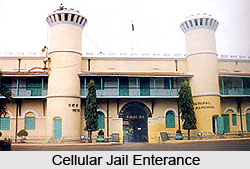
 The Cellular Jail in Port Blair is an exceptional and colossal brick and concrete structure, which symbolises the authority of the colonial rulers and their intentions to crush the political protests of the enslaved country. It also represents an eerie romance of the excruciating cries of the intrepid spirits. This jail, where numerous revolutionaries were lodged, therefore, is closely associated with the independence movement of India. It gained the name `cellular` because it is wholly made up of individual cells for the solitary confinement of prisoners.
Cellular Jail was quite remarkable in its structure. It had iron gates at the main entrance. At the entrance was the administrative block. On entering the main gate was a high roofed corridor and then there was a small courtyard on the right hand. It was here that the first `sermons` were given to the convicts to dispirit and frighten them. From here, the elevation of the jail building was visible and it emoted a bizarre look of a place with no exit gate. On further right of this courtyard was the kitchen, which was divided intentionally by the British into the Hindu kitchen and the Muslim kitchen. Adjoining the kitchen was the gallows. On the left, after crossing the corridor, was the hospital for the prisoners.
Each block of the Cellular Jail had a courtyard in front with a workshop where the prisoners worked during the day, a water tank one cubit wide and ten cubits long to hold water and a lavatory near it. These cisterns were fed water by pipes from a huge cistern outside the jail, which was filled with salt water drawn by a pumping machine from the sea. Drinking water was supplied from a pipe near the central tower.
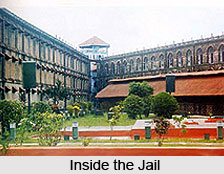 Cellular jail consisted of seven wings, each deviating towards different directions from a central tower and each wing consisting of three storeys. The central tower, representing a `three storeyed pillar or a minaret`, had the fourth storey also possibly to facilitate the watch and ward. Since each wing was like the spokes of a wheel or ribs of an umbrella and the central part like a fulcrum, hence, the coming out and going in from each wing and each storey to another was possible through the central part known as control tower. The tower housed a bell, which tolled the hour and in an emergency sounded the alarm. A guard was posted on each of the three storeys in the central fulcrum. All he had to do was to walk round like a bullock working the Persian wheel to get a clear, complete and unobstructed view of the verandah, which faced the cells on each floor of each wing. One convict warder used to be on night duty in each wing and on each floor. Therefore, at a time there used to be twenty-one warders on duty on three floors and seven wings of the jail. Their duty changed after every three hours and, thus, eighty-four convict warders remained on duty each night. In all, the Cellular Jail had 698 cells.
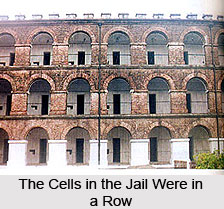
Cellular jail had no barracks or dormitories. The size of each cell was thirteen and a half feet by seven feet. Each cell had a door made of iron bars with an opening into the verandah. The doors of the cells were shut by means of iron bolts and locks from outside and their location was such that it could not be opened by the inmates from within even if one had the opportunity to do so. The cells in the jail were in a row. The verandah, approximately four feet wide, ran all along the front of the cells. On the opposite side of the cells, iron railings were fixed into the arched pillars that supported the roof of the verandah.
In order to minimise the chance of dialogue among the prisoners and to isolate them from each other, the construction of the jail was so that the front portion of each wing was to face the back of the other wing.
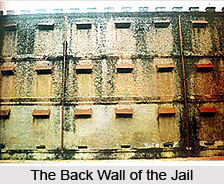
One ventilator, three feet by one and a half feet, was provided in the back wall of each cell at a height of almost ten feet from the floor of the cell. It had a slanting shade outside. One could hardly see the outside world even through the ventilator.
 The revolutionaries in Cellular Jail were not treated as political prisoners but they were called as `seditionists` or `anarchists` and were treated even more shoddily than ordinary criminals. They were given the class `D` (dangerous) or `PF` (permanently incarcerated). All kinds of torture i.e. assignment of back-breaking manual work, food, poor in quality and short in quantity were in their lot, while medical help was almost non-existent. Hurtling of abuses and flogging were a part of the routine behaviour of the jail authorities with the freedom fighters.
The Cellular Jail has, over a period time, suffered many ravages brought about by nature and man. A part of it was being used as a jail for local prisoners till recently, but now this historic jail forms the museum, housing the memorabilia of those murky days. The watchtower accommodates, on each of its three floors, the plaques bearing the names of those brave sons of the motherland who faded and some of whom attained martyrdom while undergoing barbarisms in solitary confinement in the dungeons of this "horror of horrors" named beguilingly as a `jail`.
The Cellular Jail was dedicated to the nation on 11th February 1979 by the then prime minister, Morarji Desai. The Jail marked its centenary on 10th March 2006.
Background Of Cellular Jail, Andaman & Nicobar Islands
The proposal for the construction of Cellular Jail was devised in 1890 on the recommendations of the Lyall and Lethbridge committee, but it was completed only in 1906. Before the Cellular Jail was constructed, prisoners used to be housed in barracks in Port Blair, the Ross Island and also in concrete structures on Viper Island
Visiting Cellular Jail, Andaman & Nicobar Islands
The Andaman group of islands is now considered a historical place by every Indian, due to the venerating presence of the Cellular Jail and its ghastly past. The toiling and harrowing experiences the freedom fighters had to go through, just to ensure that the future generations lived in peace, is truly brought alive by visiting the various areas within the jail.
 Inmates in Cellular Jail, Andaman & Nicobar Islands
Whatever one tries to elucidate about the conditions of the hapless inmates of the Cellular Jail, falls exceedingly short of the reality the heroes had to go through under the barbaric British. To the Britishers, the jail meant a mockery of the Indian patriots, who fought ceaselessly for India`s freedom. The prisoners were treated mercilessly right from the time they landed on the island.
Political Prisoners in Cellular Jail, Andaman & Nicobar Islands
The knowledgeable, sophisticated and polished class of prisoners were referred to as the political prisoners. Owing to their special status, they were treated with pathetic measures, and the supervising jailor of the Cellular, David Barrie was the mastermind in contempt. He was the man who declared that the political prisoners would not be treated with any special facilities, but with even worse devises.