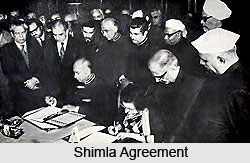
The Government of India and the Government of Pakistan are resolved that the two countries put an end to the conflict and confrontation that have hitherto marred their relations and work for the promotion of a friendly and harmonious relationship and the establishment of durable peace in the sub-continent, so that both countries may henceforth devote their resources and energies to the pressing task of advancing the welfare of their people.
In order to achieve this objective, the Government of India and the Government of Pakistan have agreed as follows:
•That the principles and purposes of the Charter of the United Nations shall govern the relations between the two countries.
•That the two countries are resolved to settle their differences by peaceful means through bilateral negotiations or by any other peaceful means mutually agreed upon between them. Pending the final settlement of any of the problems between the two countries, neither side shall unilaterally alter the situation and both shall prevent the organization, assistance or encouragement of any acts detrimental to the maintenance of peaceful and harmonious relations.
• That the pre-requisite for reconciliation, good neighbourliness and durable peace between them is a commitment by both the countries to peaceful co-existence, respect for each other`s territorial integrity and sovereignty and non-interference in each other`s internal affairs, on the basis of equality and mutual benefit.
•That the basic issues and causes of conflict which have bedeviled the relations between the two countries for the last 25 years shall be resolved by peaceful means.
•That they shall always respect each other`s national unity, territorial integrity, political independence and sovereign equality.
•That in accordance with the Charter of the United Nations, they will refrain from the threat or use of force against the territorial integrity or political independence of each other.
Both Governments will take all steps within their power to prevent hostile propaganda directed against each other. Both countries will encourage the dissemination of such information as would promote the development of friendly relations between them.
In order to progressively to restore and normalize relations between the two countries step by step, it was agreed that:
•Steps shall be taken to resume communications, postal, telegraphic, sea, land including border, posts and air links including over-flights.
•Appropriate steps shall be taken promote travel facilities for the nationals of the other country.
•Trade and co-operation in economic and other agreed fields will be resumed as far as possible.
•Exchange in the fields of science and culture will be promoted.
In this connection delegations from the two countries will meet from time to time to work out the necessary details.
In order to initiate the process of the establishment of durable peace, both the Governments agree that:
•Indian and Pakistani forces shall be withdrawn to their side of the international border.
•In Jammu and Kashmir, both sides shall respect the line of control resulting from the cease-fire of December 17, 1971, without prejudice to the recognized position of either side. Neither side shall seek to alter it unilaterally, irrespective of mutual differences and legal interpretations. Both sides further undertake to refrain from the threat or the use of force in violation of this line.
•The withdrawals shall commence upon entry into force of this agreement and shall be completed within a period of 30 days thereof.
This agreement will be subject to ratification by both countries in accordance with their respective constitutional procedure and will come into force with effect from the date on which the instruments of ratification are exchanged.
Both Governments agree that their respective heads will meet again at a mutually convenient time in the future and that in the meanwhile the representatives of the two sides will meet to discuss further the modalities and arrangements for the establishment of durable peace and normalization of relations, including the questions of repatriation of prisoners of war and civilian interness, a final settlement of Jammu and Kashmir and the resumption of diplomatic relations.