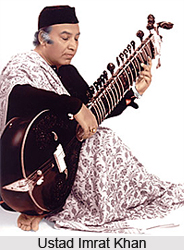
 Ustad Imrat Khan can be called the underdog, to have lived under the indomitable shadow of his rather legendary brother, Ustad Vilayat Khan. Still, due to his mother`s tenacious efforts, he was gradually able to come out of it. He was tutored under the watchful guidance of his uncle and grandfather, and of course his brother. Thus, he mastered the tricky subtleties of the tough instrument, surbahar, and in fact played brilliantly in the concerts. His jugal bandis together with his brother also prove his mettle in rendering improvisations. The effortless passion he exerts in his few memorable performances while in the alaap-jod-jhala section, or the switch over to gat in the sitar, are truly short of praise.
Early Life of Ustad Imrat Khan
A lot less flamboyant than Ustad Vilayat Khan, Ustad Imrat Khan grew up in the shadow of his lordly brother for a very long time, such that only a handful esteemed and acknowledged his independent gifts. A modest and self-effacing an, it took him a while to win the world`s recognition. Vilayat Khan wanted to become a master of the surbahar too, but was forbidden by his determined mother, Bashiran Gegum. She wanted Vilayat to become the sole monarch of the sitar and her younger son Imrat to be the king of surbahar. So, after being trained in the sitar until the age of ten, Imrat was compelled to pick up its severe sibling, the surbahar.
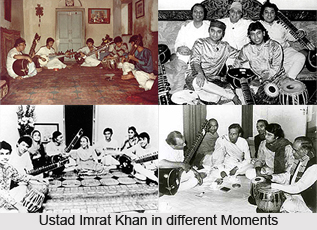 Life in Music for Ustad Imrat Khan
Thus Imrat was trained by his paternal uncle Waheed Khan, his maternal grandfather Bande Hassan Khan, as also his brother in this difficult instrument for a number of years. Imrat had to accept both the profound beauty of the surbahar as also acknowledge that it could not be used to play the gat section. His improvisations in this instrument had to be confined to the alaap section and then had to switch to the sitar while playing the gat. Yet, the improvisations he brought about in the instrument are startling. One has to listen to some of the early recordings of his father Hazrat Inayat Khan playing the surbahar to understand the distance his son covered on his own. Imrat`s tone is rounder and sweeter than his father. Yet, unlike Vilayat, he never compromised the grave and serene brilliance of the instrument for felicitous tunefulness. While Imrat introduced elements of the gayaki-ang into his style of playing, he never let it rule over him. Yet the surbahar could never command the kind of audience the more vivacious sitar does, because it does not lend itself to melodic innovations. Many remember to this day the happy times, when the brothers` duo played several memorable jugalbandis - Imrat doing the alaap on the surbahar and Vilayat playing the composition on the sitar - together in several parts of the country. They even did a jugalbandi album in Raaga Chandini Kedar.
He has since established an honoured name for himself in the portals of Hindustani instrumental music. Imrat is the only known surbahar player of genius in the country, who though rarely, frequents the concert circuit. His alaaps capture the deep dignity and stateliness of the dhrupad. One has only to listen to his resonant alaap-jod-jhalas in profound ragas like Bageshri, Malkauns, Mian Malhar, Darbari, Todi and Poorya Dhanashri to grasp the spiritual repose and tonal solidity of his style. After playing the alaap-jod-jhala in the chosen raaga on the surbahar, he switches to the sitar to play the gat section in the gayaki style. Imrat`s surbahar tradition has been continued by his exceptional sons, Irshad and Nishat Khan. Of these, Irshad plays the surbahar with great effect as is evident from his recording of Bairagi.