The Kashmiri Brahmin Community, popularly called Kashmiri Pundits, form a distinct class of their own and are considered to be the purest specimens of the ancient Aryan settlers in the Valley. They are a charming, highly cultured people. Fair complexioned, intelligent and hardworking, they are endowed with an extraordinarily artistic temperament. Most of them have a handsome physique with long or aquiline nose and beautiful eyes and Aryan features. Their women, with their lovely eyes and chiselled features, are among the most beautiful in the world. This small community is highly advanced in education, more than 70% of their members being literate. Their chief occupation is government service. In India many well-known administrators and politicians have been Kashmiri Pundits. In the field of art, philosophy and literature, they have produced a galaxy of authors, savants and saints. The Kashmiri Pundits are scattered throughout India, particularly in the northern regions and many occupy high governmental and private posts. But the majority lives in Kashmir.
History of Kashmiri Brahmins
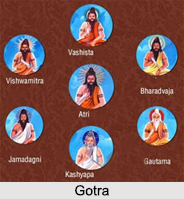
The history of the Kashmiri Brahmins is ages old. The Kashmiris form a branch of the race which brought the language of the Indo-Aryan type into India as seen in their language and physical appearance but the period of their immigration and the time they came by remain unresolved till date. They are a distinct class and are probably the purest specimen of the ancient Aryan settlers in India. The Kashmiri Pundits are divided into 133 exogamous gotras, each member of which claims to be a descendant of a rishi whose name the gotra bears. Generally, the social position is determined by the nature of occupation followed, rather than by the gotra. Those who have been employed in superior state service since two or three generations hold their heads high above others.
During their numerous political upheavals, they have suffered enormously at the hands of religious persecutors. Subsequently, during the long and peaceful reign of Sultan zain-ul-Abidin most of them returned to their original homeland. They studied the Persian language and regained their traditional occupation, namely, government service, which was held by them throughout the later periods of Mughal, Pathan and Sikh rulers. The Kashmiri Brahmins who had become well-versed in Persian got good posts under the Muslims as Persian was also the court language at Delhi. Particularly because of their good knowledge of Persian, some of the Kashmiri Pundits who migrated to Bengal, Rajasthan and Central India became Diwans of the princely states.
The new-comers assumed the appellation of Bhanmasi in contradistinction to Malmasi which the indigenous inhabitants had assumed, the Malmasis observe the "lunar" and the Bhanmasis the "solar" form of astronomical calendar, The Karkuns or government servants having given up the study of Sanskrit in favour of Persian, employed their daughters` eldest sons as their priests who were called Bachibhats. In course of time, the Karkuns and Bachibhats became two sub-castes, intermarriage between the two being restricted.
Before 1930 the Kashmiri Pundits were all-powerful in Kashmir, economically, socially and politically. But after the partition of the country their population started diminishing and is now almost on the verge of extinction.
Language of Kashmiri Pundits
Kashmiri is the official language of the Kashmiri Pundits. When Urdu language came into being they made it their language and produced monumental works. Some of them even went on to become great Urdu writers and poets. The Kashmiri Brahmins of Delhi, Lucknow and Allahabad speak fluent Urdu but many of those who left Kashmir can not speak Kashmiri.
 Dress of Kashmiri Pundits
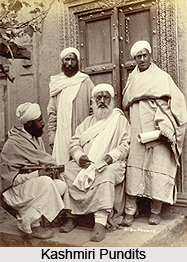
The traditional dress, the Phiran, worn by most Kashmiris (men and women) is a loose smock coming down below the knees. However those in Delhi, Mumbai, Uttar Pradesh and other parts of India dress in the Indian or European manner. The women wear saris and the younger people wear whatever is in vogue.
Food Habits of Kashmiri Pundits
Although claiming to be the offspring of rishis and belonging to the highest branch of Brahmins, the Saraswats, Kashmiri Pundits take meat freely in strange contrast to the observance of strict vegetarianism by the Brahmins all over India.
Rituals of Kashmiri Pundits
Several rituals and ceremonies have been observed by the Kashmiri Pundits which have been followed till date. For instance on the sixth day after a child`s birth, the mother and child have a ritual bath known as Shran Sunder. On the 11th day, a purification ceremony, Kahnethar, takes place when the mother leaves her room. Then a Havan is performed and the child is given its name.
When a boy is 5 years old, a hair-cutting ceremony or Moondan is performed. The head is shaved and only a tuft of hair is left on the top as is the practice among Brahmins. When the boy is 12 years old, the sacred thread is put round his neck by his guru and he becomes a Dvija (twice-born) Brahmin. In accordance with Brahminical rites he then begs alms for his guru from all those present. The money that is collected is given to the guru. The bath and anointing ceremony or Deragori include the colouring of the boy`s hands with Henna.
Marriages are mostly arranged by the parents. The horoscopes of the boy and the girl are matched by astrologers. On the wedding day, the bridegroom (who wears traditional Indian dress and a coloured turban) is made to stand on the Vyug (a design made on the floor of his house for the purpose). The oldest woman relative brings a tray of lighted lamps and releases a couple of pigeons over his head. The guests sing songs and shower coins and sugar on him. Then he goes to the bride`s house in procession where the Vyug ceremonies are again performed outside her house. The lagan (nuptial rites) is conducted by the family priests near the sacrificial fire. The couple partakes of curd and sweetmeats from the same plate. Then hand in hand they go round the sacred fire 7 times to the chants of Vedic mantras by the priests rent the air.
Till the end of the 19th century the dowry system of this community was different from what it is today. Along with the bridegroom, his parents also received gifts from the bride`s parents and in their turn, they also gave a dowry to the bride. Now the bride`s parents send the bridegroom a kilo of cream (in a silver vessel), seven thals (large trays) of sweets, a few flowers (an odd number), cloth for suits and an amount of five hundred rupees or more. In return his parents send the bride clothes, jewellery, seven or more thals of sweets, five or seven flowers, one kilo of cream and cash. The orthodox Brahmins do not eat anything cooked in the daughter`s new home.
Festivals of Kashmiri Pundits
Shivaratri is an important Kashmiri festival. It begins on the first day of the dark fortnight of Phalguna (February-March). The house is cleaned from the 5th to the 9th day and cash presents are sent to the daughters on the 10th day. On the 11th day, fish and bread are specially included in the menu. On the 13th day, the head of the family undertakes a fast and worships Lord Shiva at night. On the 14th day, a feast is held. The elder relatives receive presents from the younger. Cooked rice and meat are customarily sent to the daughters. On the 15th day, walnuts are distributed among relatives and friends.
The spring festival, called Sont, is celebrated on 15th March. Un-husked and cooked rice, a mirror, a cup of curd, a pen case, a few walnuts, a basket of un-husked rice and sweets are kept together overnight and have to be seen the first thing the next morning. Each person then picks up a walnut or two and then drops them into the nearest river in which a bath has then to be taken. Nav Warih (New Year`s Day) falls on the first day of the bright fortnight of Chaitra (March-April).
Other festivals celebrated by the Kashmiri Brahmins are Baisakhi, Jeth Ashtami, Har Navami, Punn, Kambari Pach, Dussehra and Krishna Ashtami.
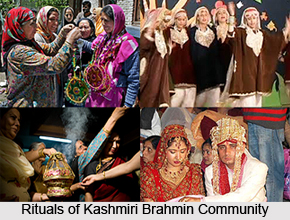
The Kashmiri Brahmins have a rich musical tradition that developed from the chanting of Hindu scriptures and the singing of devotional songs in Kashmiri at the time of the sacred thread and marriage ceremonies.
The Brahmins of Kashmir are an interesting combination of beauty and brains. Based in their Vedic Aryan background they have retained their ancient traditions but have also assimilated other cultures that flourish in India. As poets, scholars, statesmen and diplomats they continue to make their impact on the national and international scenes. Some of the well-known surnames of the Kashmiri Pundits are Wanchoo, Bhan, Kao, Gunju, Muttu, Razdan, Takru, Manwati, Panju, Gurtu, Walli, Kak, Shingloo (or Shinhlu), Thresal, Jhalan, Yan, Malla, Sapru, Kitchlu, Drulu, Dar (or Dhar), Haksar (or Hak), Bangru, Langar, Gadi, Thalssor, Kalpush, Warikim, Tikku, Lala, Minshi, Zitshi (or Zutshi), Amdarzan, Kaul (or Koul), Raina, Pulairu, Madan, Bakaya, Rawal, Kachru and Shivpuri.