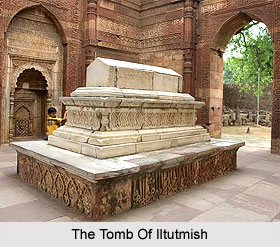
 Shams-Ud-Din Iltutmish was born in a tribal community of Ilbari in Turkestan. He looked outstandingly handsome as well as intelligent and wise from his young age. His brothers were jealous of him and they deprived him of the share of their paternal home and care. But these adversities could not mutilate his talents and soon he got a career opportunity. His accomplishments brought attention of Qutub-Ud-Din Aibak, then viceroy of Delhi, who bought him as a slave at a very high price. Shams-Ud-Din applied his intelligence and gradually rose in post until he became the Governor of Badaun. He was married to a daughter of Qutub-Ud-Din. Shams-Ud-Din Iltutmish was free from slavery as he was recognised for his services during the campaign of Muhammad of Ghur against the Khokhars. He was also elevated by post as Amir-Ul-Umara.
Accession of throne by Iltutmish
After the death of Qutub-Ud-Din Aibak, father-in-law of Shams-Ud-Din Iltutmish in 1210 A.D, the Chihalgani selected Aram Shah as the next Sultan. But eventually Aram Shah turned out to be an incapable ruler and Shams-Ud-Din replaced him. Shams-Ud-Din was given the title Iltmash or Altmush at the time of his enthronement. But he had to face several embarrassing circumstances soon after he was made king. Nasir-Ud-Din-Qabacha announced his independence in Sindh and wanted to take Punjab under his rule. Another Khalji noble, Ali Mardan, who was appointed as Governor of Bengal by Qutub-Ud-Din aibak in 1206, came out of the commitment to Delhi after the death of Qutub-Ud-Din and declared himself as Sultan Ala-Ud-din. Shams-Ud-Din Iltutmish was the third sultan of Slave Dynasty and Delhi Sultanate.
Challenges of Iltutmish
Shams-Ud-Din Iltutmish faced all situations with great courage. He first dominated the rebellion of Amir in the plain of Jud near Delhi and then took control of different parts of kingdom and took those under his dependencies like Varanasi, Badaun and Sibalik. Qubacha advanced to Lahore and was expelled by Iltutmish. He was completely overcame by Iltutmish on 1228 and later was accidentally drowned in Indus. In 1216, Taj al-Din Yildiz was defeated and killed by Iltutmish Sindh was annexed to Delhi Sultanate. One of the most notable incident was that Chengiz Khan extended his empire to the valley of Indus. In 1228, Iltutmish recognized as the Sultan of India by the Abbasid
Caliph. During his rule, in 1231 Jalal al-Din Mingbarni died in Iran.
Art and Architecture during the time of Iltutmish
Iltutmish was a man of brilliant qualities and extended his patronage to literature and arts. During his reign, Tabaqat-i-Nasiri was written by Minhaj al-Siraj Juzjani. He completed the structure of Qutub Minar on 1231-1232 AD, which was started by Qutub-Ud-Din Aibak. Shams-Ud-Din Iltutmish inscribed the name of its patrons, Sultan Qutub-Ud-Din and Sultan Muiz-ud-din on the Minar. A beautiful mosque was also built on the Sultan`s order. Iltutmish was very pious and very particular about his prayers. "Iltutmish was described in some contemporary writing as "the protector of the lands of God", "the helper of the servants of God", etc.
Iltutmish was a cultured and religious minded individual. He strictly observed rites of his religion and spent considerable time at night in prayer and contemplation. Not only that, he was a brave soldier, an experienced commander and a capable administrator. With his own merits and efforts he became the Sultan of Delhi. Iltutmish introduced Persian customs and rules in his court, patronised cultured people and scholars. All scholars, member; ruling families and capable persons who fled from Central Asia other Islamic states because of the attacks of the Mongols were provided shelter at the court of Iltutmish. Iltutmish made Delhi his capital and beautified it accordingly. Many minarets, mosques, madarsas, Khanqas and tanks were built by him. Iltutmish was a religious minded person. He strictly observed rites of his religion and spent considerable time at night in prayer and contemplation.
Sucessors of Iltutmish
Shams-Ud-Din Iltutmish died on 1236 AD. His eldest son Nasir-Ud-Din-Mahmud had died in 1229 while governing Bengal as his father`s deputy. The rest of the sons were not that much capable of administrative duty. In 1236 AD, on his death bed, Sultan Iltutmish nominated his daughter Raziya as his successor. But the nobles of the court could not accept the rule of a woman. They went against Sultan Iltutmish`s last wish and killed her and his husband in 1240. They nominated Sultan`s eldest surviving son, Rukn-ud-Din Firuz as a next ruler. After Iltutmish died Delhi`s political situation faced an extreme turmoil as four descendents of Iltutmish were crowned and murdered successively. Then Balban became the Naib or Deputy Sultan and later he became Sultan on 1265 AD and only then the order and peace was re established.