 Gangaikondacholapuram is a historical village of South India, situated 36 km north of Kumbakonam. The village lies on the northern bank of the famous river Kollidani in Tamil Nadu. Rajendra Chola I, who was in rule from 1012 to 1044 A.D constructed Gangaikondacholapuram and its temple.
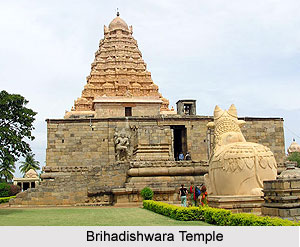
Rajendra, the able successor of Rajaraja Chola I shifted the Chola capital from Tanjavur to Gangaikondacholapuram. He built the famous Brihadishvara temple in Tanjavur.
The new capital was built in his remembrance and to give tribute to his successful military campaigns that took him as far as the river Ganga in North India. The name of the village Gangaikondacholapuram exactly means `the city of the Chola who conquered the Ganga`.
Rajendra built a temple in Gangaikondacholapuram village dedicating to Lord Siva in the form of `Gangaikondachola Isvara` or `God of the Chola who conquered the Ganga`. There is a massive Nandi sculpture in front of the entrance. One can enter main sanctum through a series of mandaipeis or pavilions. There is a beautiful sculpture representing the Sun and eight planets on an altar in the corner of one of the halls of the temple. This sculpture is carved in the form of a full-bloom lotus resting on a two-tiered square pedestal. Many beautiful sculptures can be seen on the outer walls of the shrine. One of these sculptures is that of Chandesanugrahamurti viz. Siva and Parvati blessing the devotee Chandesa. It is the most marvelous sculpture among them. One more sculpture of Saraswathi, the Goddess of Learning, seated on a lotus can also be seen.
The main sub-shrines of this temple in Gangaikondacholapuram include those dedicated to Chandikesvara and Mahishasuramardini (Durga). One more attraction of the place is the `simhakeni` or the lion-shaped well in the temple campus. It looks very fascinating.
It is said that Rajendra himself poured the water of the holy Ganga into this well. Till then, the well has never gone dry and its water is still used for the ritual bathing of the deity. The ruins of the `Ponneri` lake meaning `golden lake` can be seen near the Gangaikondachola Isvara of Gangaikondacholapuram. The remnants of Rajendra`s palace can also be seen nearby. Recently, the Gangaikondacholapuram temple has been declared the as a World Heritage Site by the UNESCO.