 Soon after the death of the Prophet Mohammad, Abu Bakr, the disciple of Mohammad rose to power as the Caliph or Khalifa or representative of the prophet and after him, he was succeeded by Omar. When Omar died, the entire Persia was captured by the Arabs by 644 A.D. and further they extended their power to the foot of the Hindukush Mountains by 650 A.D. Also in the West, they subjugated over the regions of Syria from the Emperor of Constantinople, Egypt, North Africa as far as the Atlantic sea board. Within the century of demise of the Prophet, the Muslims overpowered the regions of West and East alike. After surmounting these regions the directions of East and West had large echoes with the call of Allah-o-Akbar meaning God is great.
Then onwards, the northern front of the Arabian empire was extended to the Oxus beyond the Hindu Kush. Frequently after this, the regions were captured one after the other, the region of the Sulaiman and Makran Mountains, occupied by the Afghans and Baluchis were attacked and the Arabs entered and disseminated into the city of Kabul. Thenceforth infrequent attacks begin on India, the neighbourhood region of Lahore and Multan. But no permanent occupation of the country was attempted till the conquest of Sind by Muhammad Bin Kasim. There have been various Arab declines on Sind possibly by the sea of the nature of piratical voyage in the later half of the seventh century. The conquest of the Sind was the final war which began as early as the caliphate of Umar in the 636A.D. With there naval assault on Thanah near Bombay and on Broach. Sind was then ruled by a Hindu prince called as Dahir by the Muslims, whose capital was at Alor near Bakhar and he ruled the country as far north as Multan.
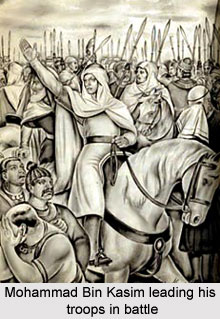
Mohammad Bin Kasim carried out invasion from the south of Persia into the country of the delta of the Indus. He captured the town of Dewal, a seaport and then following the river went into the interiors, on the way overpowered the town of Nerun near Hyderabad at present and Sehwan. Then he vanquished Dahir near Alor and captured the latter place by assault. The Rajput battalion of the city when came to know that further confrontation would be impossible, he sacrificed his wife and children into flames of firewood and himself storm on the enemy and died besides a man. Multan was captured by the oppositions who were not even scratched and remained unopposed and all the power of Raja Dahir went into Arab`s hands.
The Muhammadan writers say that Kasim planned to march towards Kanauj, the famous city of India to expand the Arab kingdom, but abruptly he was arrested and put to death by the order of caliph. A descendant of Kasim made assail on the state of Ujjayini and other places, another invasion into Gujarat is mentioned by Arab historians and another place known as Valabhi is said to be destroyed because of frequent attacks of Arab. The victory of Arabs over the Gurjara-Pratiharas of Kanauj was not successful because they were able to resist the attack of Arab throughout the ninth century. Further they came to be recognized as unfriendly to the Arabs.
The captured land continued to be under the hands of the caliphs for about a century but the caliphs send little or no aid to the governors. Then they were excluded from Cutch in the beginning of the ninth century. The Arab settlers in Sind set up their own Empire at Multan and Mansuriya, while the smaller chiefs set in the neighbouring region of Makran. There the Arabs carried out trade on the Bombay coast with the support of Rashtrakutas. Karmathian misbelievers and mixture of Arab and native descent flourished in the valley of the Indus and destroyed the states of Multan and Mansuriya around 985 A.D. From this region they were finally expelled by Sultan Mahmud of Ghazni.