Dyarchy in India - Informative & researched article on Dyarchy in India
 Indianetzone: Largest Free Encyclopedia of India with thousand of articlesHistory of India


in  
 Art & Culture|Entertainment|Health|Reference|Sports|Society|Travel
Forum  | Free E-magazine  | RSS Feeds  
History of India : Sources of History of India |Ancient History of India |Medieval History of India |Modern History of India |Indian Historical Dynasties |Indian Battles |Sepoy Mutiny 1857 |Indian Rulers |History of India |Indian Freedom Struggle |Indian Governor- Generals |British Indian Acts |Post Independence India |Iron Age in India
Home > Reference > History of India > Modern History of India > British Empire in India > Administration of British Empire > Dyarchy in India
Dyarchy in India
It means the government was unsuccessful and due to which local administration grew stronger and even manipulative.

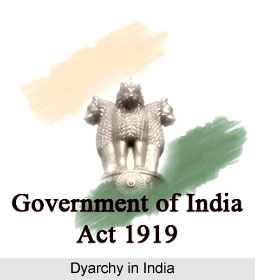
 Dyarchy in IndiaWith the arriving into power of the Government of India Act 1919, local self-government became a `transferred` field under democratic ministerial control. Government of India no longer brought out any direction for regional governments and each province was permitted to grow local self-institutions, according to provincial demands and necessities. Under the Scheduled Taxes Rules, the taxes which could be imposed by local bodies were divided from those which fell inside the capability of regional governments. The Indian ministers could not do much work in the field of local self-government, due to deficiency of funds, since finance was a `reserved` issue under the jurisdiction of an Executive Councilor.

In May 1930, the Simon Commission cited the massive financial powers implemented by local bodies. It observed that the village panchayats had not depicted any noticeable progress in U.P. Bengal and Madras. The commission proposed the retrograde step of elevating the command of provincial governments over local bodies in the sake of keener skilfulness and quoted the example of England "by numerous administrative devices, by inspection, by audit, by giving of grants-in-aid on conditions ensuring efficiency and by insisting on standards of competence in the municipal staff, the local Government Board and its successors, the ministry of Health have steadily raised the standard of administration in local authorities". Commenting on the deprived financial condition of local organisations, the Commission negatively remarked on the unwillingness of the elected members to enforce taxes and stated that the management of finances of local organisations had degenerated after the introduction of the Reforms of 1919 and the sloppiness could not be effectively corrected by insufficient powers of audit, owned by regional governments.

(Last Updated on : 16/04/2012)
 
 
Medical Conditions during 19th Century Scientific Associations in British India History of Establishment of Cotton Industry in India
History of Beginning of Tea Industry in India British Land Revenue System in India Montagu-Chelmsford Reforms
Butler Committee Hunter Committee Welby Commission
Indian Factory Legislation Public Services Commission Indian Financial Reform
Policy of Equal Federation Policy of subordinate Union Dyarchy in India
Subsidiary Alliance System The Decentralisation Commission Report, 1908 The Resolution of May 1918
Morley-Minto Reforms Act Growth of Constitution under the Company`s Rule Growth of Representative Government in India
Delhi Durbar of December 1911 Administration of Punjab Imperial Service Troops
Batta Crisis Military Administration in British India British Administration During Second World War
British Policy in India Rowlatt Committee  
Recently Updated Articles in History of India
National Investigation Agency
National Investigation Agency (NIA) was created by the Indian Parliament to enable the detection, prevention, investigation and prosecution of terrorism-related incidents in India on a national scale.
Battle of Malpura
The crisis that developed in the relationship of Jaipur and Sindhia`s Government, nurtured the battle of Malpura.
Seige of Panhala fort
Seige of Panhala fort was undertaken by the joint forces of the Adil Shahi kingdom. Shivaji managed to successfully escape from this fort while it was still under siege by the Adil Shahi forces thus rendering the siege useless.
Purandhar Fort
Battle for Purandhar Fort saw a rather strong defence being provided by the Maratha forces. The battle ended in peaceful negotiations as it was realised by the offenders that they were merely losing their men and were nowhere near capturing the fort.
Battle in Poona
Battle in Poona saw a crushing defeat of the Mughals by the Maratha leader Shivaji. After the battle, the defeated Shaista Khan was transferred to the Bengal as punishment for embarrassing the Mughals with this defeat.
E-mail this Article | Post a Comment
Forum
Forum on History of India
Free E-magazine
Subscribe to Free E-Magazine on Reference
 
 
Dyarchy in India - Informative & researched article on Dyarchy in India
Sitemap
Contact Us   |   RSS Feeds
Copyright © 2008 Jupiter Infomedia Ltd. All rights reserved including the right to reproduce the contents in whole or in part in any form or medium without the express written permission of
Jupiter Infomedia Ltd.