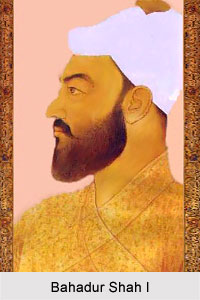
 With the death of Aurangazeb in March 1707, at the age of eighty-nine, a war of succession had started between his three sons for succession to the throne. These heirs are the later Mughal Emperors. The sons of Aurangazeb are namely- Prince Muazzam, Muhammad Azam and Kam Bakhsh. The eldest son, Muazzam ousted and even murdered his brothers, Muhammad Azam at Jajau on June 18, 1707 and Kam Bakhsh in a place near Hyderabad on January 13, 1709. The new emperor assumed the title of `Bahadur Shah I`. Being an aged man of more than sixty-three, he was not fit for active leadership. The reasons may be wide-ranging; either the outcome of statesmanship or physical weakness was setting within Bahadur Shah I; the emperor supported a mollifying policy. For instance the Maratha Prince, Shahu, who had been a captive of the Mughals since 1689, was released and was also permitted to go back to Maharashtra. The Rajput leaders were also being confirmed their respective states, in the process peace prevailing within the Empire. However, Bahadur Shah came into conflict with the Sikhs, whose leader Banda had terrorised all the Muslims of Punjab. Thus Lohagarh, Banda was overpowered and the Mughal rulers re-occupied Sirhind in January 1711. However the Sikh power could not be crushed totally. At last Bahadur Shah came face-to-face with death on February 27, 1712. He was one of the significant late Mughal Emperors. The famous historian and researcher, Sidney Owen said, "He was the last Emperor of whom anything favourable can be said. Henceforth, the rapid and complete abasement and practical dissolution of the Empire are typified in the incapacity and political insignificance of its sovereigns".
It is obvious that a war of succession would break out once again in 1712 amongst Bahadur Shah I`s 4 sons, namely- Jahandar Shah, Azim-us-Shan, Rafi-us-Shan and Jahan Shah. This bitter tiff came to an end with Jahandar Shah ascending the throne with the help of an important member from the `Irani party`, Zulfikar Khan. Jahandar Shah selected Zulfikar as his prime minister. However Farrukhsiyar, son of one of his brothers Azim-us- Shah, challenged the power and position of Jahandar Shah. In this way he received help of the Sayyid brothers, Abdulla Khan Na Hussain Ali. Jahandar was nevertheless defeated and murdered on February 11, 1713. As a mark of appreciation and gratitude, Abdulla Khan was made the `Wazir` and Hussain Ali `Mir Bakshi`, by Farrukhsiyar during 1713-1719. Later, the emperor hatched conspiracy to get rid of the Sayyids. However, the later Mughals were very clever and killed Farrukhsiyar on April 28, 1719. One of the greatest achievements of this important ruler was that, during his reign the Mughals had successfully overpowered the Sikhs. The then leader Banda Bahadur was imprisoned at Gurdaspur and later was executed in Delhi on June 19, 1716. In the following year i.e. 1717, the Emperor granted numerous privileges for trading with the British East India Company.
Therefore the Sayyid brothers were the next line of rulers after Farrukhsiyar`s death. Rafi-ud-Darajat reigned from February 28 to June 4, 1719; Rafi-ud-Daula ruled from June 6 to September 17, 1718. Another Sayyid ruler, Muhammad Shah had established his domination from September 1719 to April 1748. In the mean time the Marathas under the leadership of Peshwa Baji Rao I raided Delhi in March 1737 that had terrorised the then emperor Muhammad Shah. Nadir Shah`s invasion on India left the Mughal Empire virtually paralysed.
Ahmad Shah and Alamgir II were the next Mughals to ascend the throne. While Ahmad Shah had ruled from 1748 to 1754, Alamgir had governed from 1754 to 1759. However these two emperors were too weak to resist the already existing problems. The last nail to the coffin of the Empire was the consecutive assaults of Ahmad Shah Abdali, an Afgan ruler, from the northwest. He made successful invasions on 1748, 1749, 1752, 1756, 1757 and 1759. Shah Alam II and his successors were only puppets in the hands of their own nobles or British rulers or the Marathas. In 1803, the Britons captured Delhi and conflict with the existing Mughal emperors continued till 1858, when the last of the Mughal Emperors, Bahadur Shah Zafar was sent to exile in Rangoon.