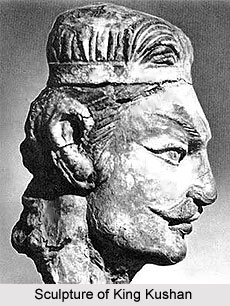
 The Kushana Empire founded by Kadphises II experienced thriving prosperity and magnificence till the time of Kanishka I. Historians have opined that Kanishka was the famous ruler, under whom Kushana Empire not only attained prosperity in the fields of art, architecture, literature and sculpture but also was stretched to a vast extent. Kanishka I ruled for 23 years. However his successors could not maintain the administration of such a vast Empire properly. This resulted in complete breakdown of the administrative machinery. Simultaneously the weak heirs could not retain their former glory in cultural fields too. Hence the Kushana empire in the hands of the weak successors of Kanishka I existed in a lesser glory.
Vashiska succeeded the throne of Kanishka after his death in 101 A.D. Vashiska, according to historians, was probably the son of Kanishka, because he was Kanishka`s immediate heir. Within a brief period of 4 years only, Vashiska seemed to have lost control over the distant parts of Kushana Empire. The inscriptions of Vashiska found in Mathura and Sanchi proved that the Kushana king Vashiska extended his sway over Mathura along with the adjoining regions of U.P and also the Bhopal state of Central India. Later scholars have identified Vashiska with Jushka, mentioned in `Rajtarangini` by Kalhana and they have also opined that king Vashiska probably ruled over the regions of Kashmir. The Kushana power suffered temporary decline under him. Vashiska, in the dying days of his reign ruled conjointly with his successor Hubiskha.
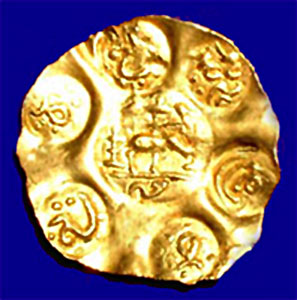
Hubiskha ascended the Kushana throne in 106 A.D. He was the successor of Kushana king Vashiska. Hubiskha was identified with king Hushka of Rajtarangini, who founded the city of Hushkapura in Kashmir. The city of Hushkapura has been identified by Sten Konow with Uskur in the Barmula Valley of Kashmir. The Kushana king Hubiskha ruled from 104 to 138 A.D. Hubishka, the successor of Vashiska, was credited to have revived the former glory of Kushana Empire, lost during the time of Vashiska. Since Hubiskha was a mighty conqueror, he restored the territories lost by Vashiska, the immediate successor if Kanishka I. During his extensive reign of 34 years, he reinstated the former status of the Kushana Empire in the history of ancient India. The extension of his Empire can be proved from his own inscription in the Brahmi and Kharosti scripts. The territories of Mathura, U.P, North Western India, eastern Afghanistan etc. were under the authority of the Kushana king Hubiskha. Not only as a conqueror, Hubiskha also attained prosperity as a king. Hubiskha was a benevolent king and was also tolerant towards other religious creeds, though he was a follower of Buddhism. He constructed a monastery in Hushkapura, where the famous Chinese pilgrim Hiuen Tsang lived as a guest. As a patron of Buddhism, Hubiskha constructed many monasteries in Kashmir and Mathura. That he was tolerant towards the promotion of other religious creeds in his Empire is evidential from the coins issued by him. The coins of Hubiskha represented a number of deities of Hindu, Buddhist, Persian and Greek origin. The discovery of a large number of copper and gold coins of Hubiskha proved the prosperity of his reign. Historians have also suggested about the flourishing trade relations of the Kushanas with the Hellenic countries during the reign of Hubiskha.
Hubiskha ruled conjointly with Kanishka II. Though there was some confusion about the identity of Kanishka II, historians have identified him as the son of Vashiska. Kanishka II assumed the high sounding title of Maharaja-Rajatiraja-Devaputra-Kaisara. Luders has pointed out that these titles suggest the ancient notion of four emperors-- the Indian Maharaja, the Iranian Rajatiraja, the Chinese Devaputra and the Romana Kaisara. Very little is known about the reign of Kanishka II. He built the city of Kanishkapura in Kashmir and historians after a prolonged research have opined that Kanishka II might have died before Hubiskha.
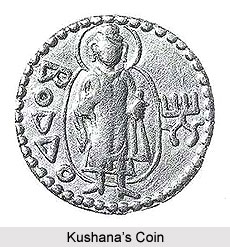 Vasudeva I succeeded Hubiskha to power. According to historians the Kushana King Vasudeva was the son of Hubiskha. Dr. B. N Mukherjee has pointed out that the date of ascension of Vasudeva I to the Kushana throne was 145 A.D. Though there is no clear evidence about the reign and extent of the Empire of Kushana king Vasudeva, yet his coins sheds some light on his reign. The coins of Vasudeva I bears his full title Shaono Shao Vasudeva Koshana. From the numismatics and epigraphic evidences of his rule it can be suggested that Kushana power had considerably declined in the northern and northwestern parts of India during his time, probably due to the revolt of the local chiefs and governors. Since most of the inscriptions of Vasudeva were concentrated in the Mathura region of U.P, it was presumed by the scholars that his authority was confined to the region of U.P only. There is however another view regarding the extent of Vasudeva`s Empire. A group of historians have suggested that the sway of Vasudeva I`s Empire extended upto Gandhara region in the Northwest. Out of the 531 Copper Plates found in Taxila, only one belonged to the Kushana king Kanishka II and the rest were properties of the Kushana king Vasudeva I. However the reign of Kushana king Vasudeva I is still a subject of keen controversy among the scholars. Though Vasudeva I belonged to the Kushana bloodline, his religious policy did not conform the Kushana trend of following Buddhism as the state as well as personal religion. Rather his religious policy proved his Saiva leanings. Moreover he was the founder of Vaishnav faith. With the death of Vasudeva I in 176 A.D, forces of disintegration began to set within the Kushana Empire, which was already in the verge of downfall.