 100 kms away from present day Pune is Ahmadnagar in Maharashtra that holds a glorious past. This little town once belonged to theThe Nizam Shahi kingdom and was one among the five Muslim kingdoms, which became autonomous after the fall of the Bahmani kingdom. It was in 1490 A.D. that Malik Ahmad who had till then been the governor of Junnar assumed independence. He was originally the son of a Brahmin of Vijayanagara whose name was Tima Bhat who had been captured when he was a young boy by the Bahmani Sultan Ahmad Shah and converted to Islam and called Nizam-ul-Mulk Bahri.
Malik Ahmad was a great general, conqueror and administrator and his greatest achievement was capturing the hill fortress of Daulatabad as it greaty increased his power and prestige. It was this ruler who laid the strong foundations of the Nizam Shahi dynasty which continued till 1636 A.D. when it was conquered by the Mughal ruler Shah Jahan. The last great Mughal emperor, Aurangazeb spent the latter years of his reign in this region.
The continuous warfare between Ahmad-nagar, Bijapur and Golconda for supremacy in the Deccan was an important aspect of the politics of the Deccan during the reign of the Nizam Shahis was. The smaller Deccani rulers, Berar and Bidar often joined one or the other of the larger kingdoms by frequent matrimonial alliances between these dynasties. In 1565 A.D. the Nizam Shahis along with other Deccani Sultans met the Vijayanagara army in the battlefield of Rakshasi Tangadi (Talikota) where they defeated the latter.
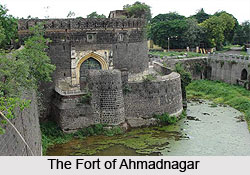
The fort of Ahmadnagar first built during the reign of the Nizam Shahis was used by the British to house Nehru and other Indian nationalists before Indian independence; a few rooms have been converted to a museum.This fort has a long drawn history. It was later captured by the Marathas and remained in their hands till General Wellesley captured it. In 1945 many Indian patriots like Pandit Jawaharlal Nehru, Sardar Vallabhai Patel, etc were detained in the fort. Jawaharlal Nehru wrote his famous book The Discovery of India in this fort.
Ahmadnagar, under the Nizam Shahis was one of the regions in the Deccan where the arts prospered and glorious developments took place here along with the kingdoms of Bijapur and Golconda. The style was much the same in the three kingdoms possibly because of the painters of this age migrated from the court of one Sultan to another often.
The unique style of paintings in these Deccanese kingdoms reflects refinement and sophistication with much decoration, which are very different from the ones of the contemporary Mughal age in the North.