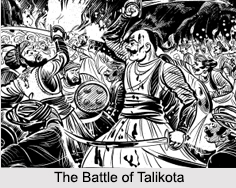
 The Battle of Talikota was extremely catastrophic to bring ruins amid scenes of savage massacre. The battle was fought between the Vijayanagara Empire under the emperor Rama Raya and the Deccani Sultans of Golconda, Bidar, Bijapur and Ahmadnagar on 23rd January 1565 at Talikota. The place is currently situated in northern Karnataka, which is 80 km southeast of Bijapur. Vijayanagara Empire was defeated in this battle, which was the beginning of the end of the mighty Vijayanagara Empire.
Location of Battle of Talikota
The name Talikota is believed to be a misnomer since this battle did not take place at the village of Talikota, but at a distance of approximately 25 miles south of it, on the banks of the River Krishna where it merges with the river Malapahari. Some call it the battle of Rakshasi - Tangadi because it was fought between these two villages.
Cause of Battle of Talikota
It is believed that the main cause of the Deccani Sultans joining together was the collective envy of these Muslim rulers towards the glorious empire of Vijayanagara and according to some scholars, was the result of Rama Raya`s high-handed policies.
How the Battle of Talikota was Fought
The empire of Vijayanagara was established in 1336 A.D. on the banks of the river Tungabadhra, which is a part of Karnataka currently. The Deccan Sultanates of the north of Vijayanagara attacked Aliya Rama Raya"s army near the villages of Rakkasagi and Tangadigi. Initially, Vijayanagara army was winning the war but two of their Muslim generals were disloyal so they joined the united Deccan Sultanates. They captured Aliya Rama Raya and beheaded him on the battle field. After the battle, Deccan army plundered Hampi and turned it into ruins.
Outcome of Battle of Talikota
According to historians, the greatest factor of the defeat of the Vijayanagar Empire was the betrayal of the Vijaynagara Army by the two Muslim commanders. They say, the defeat of the Vijayanagara army did not lead to any substantial political gains for the allied forces. Earlier, the Deccani Sultans had maintained a very efficient army because of a fear of a potential war at any time, but after this decisive battle of 1565 A.D., they became complacent and also quarreled among themselves. This ultimately led to their demise on the hands of the Mughals of Delhi.