 The Shungas ascended the throne of Magadha after the Mauryas in 185 B.C. The Mauryas were famous in ancient India because of the cultural resurgence during their rule. However the cultural revival of the Mauryas was not destined to continue for long. During the reign of the Shungas, the successors of the Mauryas in the Magadhan throne, art style initiated by the Mauryas had declined. In fact Shunga art stood at opposite poles from the Mauryan art. According to N.R. Roy, the Mauryan art had an elitist and court culture. But Shunga art was completely free from the court culture and grew out of folk art synthesised with Buddhist ideas. The Shunga art owed it legacy from the Harappan art and some exotic ideas that came into the land. The Shunga-Kanva art, essentially native in spirit, crossed the limit of the Mauryan art as it contained exotic ideas.
Chaitya Architecture was the sculptural idiom of the Shunga-Kanva Art. The carving of chambers called chaityas into living stone/hill-sides, reached its zenith during this period, with the construction of elaborate and complex halls, generally with only one window for light. These spectacular examples of giant sculptures were painstakingly cut only with the help of human labour, to serve as meditational retreats resembling caves into the escarpments of Western Ghats in present day Maharashtra. Although the Shungas` reign of 112 years saw the decline of Buddhism as the Imperial religion, yet the earliest amongst these chaityas is the Buddhist chaitya hall at Bhaja, dating from the middle of second century B.C. The Bharhut Stupa, which was built in the middle of second century B.C, has not survived the ravages of time. The Sanchi Stupa was rebuilt in the second century B.C and four entrances were added to the four corners. These gates were famous for their sculptural intricacy. The statues carved on the railings of Sanchi and Bodh Gaya are an extinct relic of the Shunga sculpture. The story of Buddha`s life engraved on stone with great perfection in the form of relief or Yaksha images, articulates the spirit of Shunga architecture. The Bharhut style is modest, restrained and had an inherent sublimity. The sculptural phrase of Bodh Gaya style had omitted the detailed description of the life of Buddha and had concentrated on expression. According to Dr. Saraswati the Bharhut style was descriptive, suitable for the understanding of the common man who are not familiar with the life of Buddha. But the architecture of Bodh Gaya, the exquisite representation of the Shunga-Kanva art, devoid of earthiness was more beautiful and artistic.
The Sanchi style articulates the essence of the Shunga architecture, which is a blend of indigenous architecture with Buddhist ideas. The sculptural style of Sanchi crossed the limitations of Bharhut and Bodh Gaya and reached a stage of extraordinary perfection. The stone railings of Sanchi are meticulously designed, and the four gates are fabricated with carved stone relief depicting the folk life, folk festivals in its period of joy and sorrow. One of the important features of the Sanchi sculpture during the Shunga age was the carving of human images synthesising the physical beauty with the inward spirit. The joy of life, which was a significant feature of the Shunga architecture, is expressed fully in the smile of the yakshinis, in the revellry of procession and in the devotional posture of the couples. Animals were also part of the sculptural idiom of Sanchi style.
Apart from Bharhut, Bodh Gaya and Sanchi, some of the cave reliefs of Udayagiri and Khandagiri also belong to the Shunga period. The Manchapuri reliefs are more perfect than Bharhut. The Bhaja reliefs date back to second century B.C., which were specimens of delicate intricacy of Shunga architecture. The sun relief, where the sun God is shown driving the chariot of four horses and the Indra relief where the divine elephant or Airavata is carrying him on his back, can be considered lively and realistic of the Shunga architecture. The Karle chaitya relief is a typical example of Shunga art, highly imaginative, emotional and beautiful.
The Shunga sculpture emphasised more on the indigenous elements and the architectural masterpieces are derived from the folk culture and hence are closer to everyday life. The Shungas during their time had held a special position in the field of art and sculpture, though they could not maintain the erstwhile magnificence of the art and sculpture of the Mauryas.
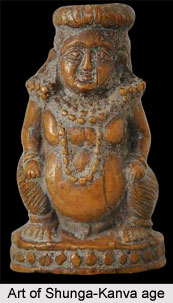
Art of the Shunga-Kanva age
The Shunga art was the harmonisation of indigenous elements with Buddhist ideas.