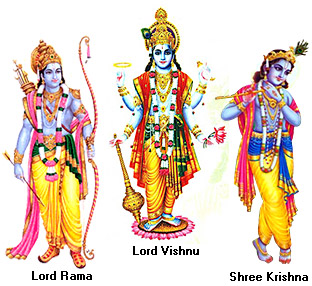
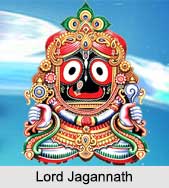
 Lord Jagannath is believed to be a deity form of Lord Krishna. Sri Jagannath is also believed to be an incarnation of Lord Vishnu, the second in the Holy Hindu Trinity of Gods (Brahma, Vishnu and Maheswar). Amongst the Vaishnavas, Lord Jagannath is considered to be the most merciful Lord in the world.
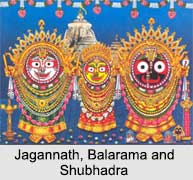
Lord Jagannath, along with his siblings, Balarama and Shubhadra are the prime deities of the Temple of Puri. The oldest and most famous Jagannath idol is in the Jagannath Temple of Puri, in Odisha. It is one of the four Holy "Dhamas" of India including temples at Rameswaram, Dwaraka and Badrinath.
Etymology of Lord Jagannath
The term Jagannath is a Sanskrit term; a compound term where "jagat" means universe and "nath" means master.
 Iconography of Lord Jagannath
The image of Lord Jagannath has no legs and only stumps of arms. Jagannath appears together with his brother Balarama and sister Shubhadra. The latter two images are also devoid of hands and feet. These three images are worshipped in all the Jagannath temples, situated mostly in the eastern part of India.
Legends about Lord Jagannath
A traditional story is associated with the deity of Jagannath. Lord Krishna appeared before King Indradyumna and ordered him to carve a deity from a log that he would find washed up on the seashore. A mysterious old Brahmin carpenter appeared before him to make the idol of the deity. The carpenter insisted that nobody should disturb him during the making of the paragon of the deity. He enclosed himself within an isolated room in the palace and continued with the carpentry. The King waited anxiously outside the room and it took a very long time. Then a moment came when the king could hear no sound from the room. King Indradyumna was very impatient and apprehended the worst had happened inside the room. He opened the door with great anxiety and found the deity in half-finished condition, while the carpenter has vanished.
The mysterious carpenter was none other than Lord Vishwakarma himself, who was the architect of the Gods. The king was extremely agitated as the deity was without arms and legs. He was much repentant as he had disturbed the carving. King Indradyumna was only pacified when the divine sage Narada appeared before him and explained that the form of the deity is the legitimate form of the supreme personality of God and after that Jagannath, Balarama and Shubhadra were worshipped with great veneration.
Ratha Yatra Festival of Lord Jagannath
The Ratha Yatra festival, the parade of the chariots of Lord Jagannatha, Shubhadra and Balarama, is yearly celebrated at the home of Lord Jagannatha called Jagannatha Puri. As the legend goes, every year Lord Jagannath, accompanied by His brother Balarama and sister Shubhadra leaves the temple to visit his aunt. The three of them are pulled in huge stringed chariots (Rathas) and the king of Puri himself sweeps the roads with a golden broom for the Lord of the World to pass. The deities stay there for seven days and are taken back to the original temple with another procession. It is believed that observing the Ratha Yatra and pulling the ropes of the chariot leads one to salvation from the cycle of birth and death.