Lord Ganesha is one of the most popular Hindu Gods, who is widely venerated throughout the world. He is the son of Lord Shiva and Goddess Parvati. He is extensively worshipped by Hindus, Buddhists and Jains as well. Ganesha, the God with the head of an elephant and riding a mouse, is considered the deity of good fortune, new ventures and wisdom. He is also believed to be the Lord of letters and the destroyer of pride, selfishness and vanity. He is worshipped before the commencement of any new venture or rituals and is regarded as the Remover of Obstacles and Lord of Beginnings. He is also known as "Vighneshvara", the God of wisdom and intellect and the patron of sciences and arts.
Etymology of Lord Ganesha
The name "Ganesha" is a Sanskrit word, joining the words "gana" which connotes group, multitude and "isha" meaning lord or master. Lord Ganesha is known by several other names including Ganapati, Vighnesa, Vinayak, Lambodara, Gajanana, Vighneshwara, Surpakarna and Ekadanta. The Hindu deity is known as Pillaiyar or Pille (meaning noble child) in the Tamil language.
Iconography of Lord Ganesha
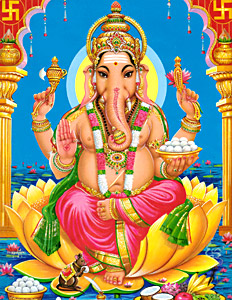
Lord Ganesha is generally portrayed as a pot bellied figure with yellow or pink skin, four arms and with an elephant head that contains only one tusk. In his four arms, Ganesha holds a shell, a chakra, a mace and a water lily. He is often shown riding on or attended by a mouse, which is his vehicle or Vahana. The divine mouse represents the subjugated demon of vanity and importance. He is often shown carrying a bowl of sweet-balls, called a Modaka which is one of his iconographic elements.
History related to Lord Ganesha
Lord Ganesha appeared as a distinctive Hindu God during the Gupta Period from the 4th Century and the 5th Century. But he incorporated attributes from the pre-Vedic and Vedic eras. During the 9th century, the Ganapatya sect emerged. It was a division of worshippers who recognized Ganapati as the Supreme God. The Ganapati Atharvashirsa, the Mudgala Purana and the Ganesha Purana are the foremost scriptures that were devoted to Lord Ganesha.
 Legends of Lord Ganesha
There are several versions related with the origin of Lord Ganesha. The most popular version mentions that Lord Shiva and Goddess Parvati were leading a peaceful married life on mount Kailash. Parvati had nothing much to do throughout the day. Lord Shiva, along with his divine bull Nandi and host of ghosts, remained mostly immersed in deep meditation. Parvati in order to come out of boredom wanted someone to keep her company. She began to call upon Lord Vishnu to grant her a son. Vishnu soon granted her wish and Parvati gave birth to a beautiful boy child whom she named Ganesha.
Goddess Parvati was so pleased at his birth and so proud of his beauty that she invited all the Gods and Goddesses to come to Kailash and admire him. All the celestial beings came and blessed the boy except Lord Shani Deva, who was the brother of Parvati. This was because Shani was cursed by his wife and the impact of the curse was that as soon as he looked at someone that person was instantly reduced to ashes. Lord Shani was reluctant to see his nephew but Parvati was so elated that she pleaded him to at least give one look. After much pestering and deference to her wish, Lord Shani hesitantly cast his eyes on the baby.
As soon as Shani Deva saw the noble child, the head of Ganesha flew off. Lord Brahma, who was present at this time, comforted Parvati and said that if the head of the first creature that was found would be cut off and transplanted on the neck of Ganesha, he would regain life. Lord Vishnu went in search of creature and in the process found an elephant dozing on a riverbank. He immediately cut off its head and came back. Thus when the elephant head was transplanted on the child`s neck, Ganesha regained back his life and took his present form.
Vahana of Lord Ganesha
Lord Vinayaka or Ganesha is generally depicted as riding or being attended by a shrew, mouse or rat. In the Mudgala Purana, it is described that the Lord has 8 incarnations. He is accompanied by a mouse in 5 incarnations. In the incarnation of Vakratunda, his vahana is a lion; as Vikata, he is accompanied by a peacock; and in the incarnation of Vighnaraja, Lord Ganesha has the divine serpent Sesha as his noble vahana.
 According to the Ganesha Purana, he has 4 incarnations, namely Mohotkata, Mayuresvara, Dhumraketu and Gajanana. Mohotkata is accompanied by a lion, Mayuresvara has a peacock, Dhumraketu incarnation includes a horse, and the incarnation of Gajanana rides a mouse. In the depictions of Lord Ganesha in Jainism, he is shown with as various vahanas like peacock, ram, tortoise, elephant and mouse.
Worship of Lord Ganesha
Lord Ganesha is venerated during various religious and secular events, particularly at the launch of ventures. He is worshipped throughout the nation across all castes and religions. It is believed that the Lord grants accomplishment, success and protection against misfortune. Devotees offer modakas and laddoos to Ganesha during rituals and prayers.
Mantras of Lord Ganesha
Lord Ganesha is revered at the commencement of prayers, important activities and religious rituals and ceremonies by Hindus of all castes. Sacred Mantras like "Om Shri Ganeshsya Namah" and "Om Gam Ganapataye Namah" are frequently chanted by the devotees.
Festivals of Lord Ganesha
Vinayaka Chaturthi, popularly known as Ganesh Chaturthi, in the Shukla Paksha during the month of Bhadrapada is one of the most widely celebrated festivals in India related to the lord. The festival of Ganesha Jayanti is also celebrated on the Chaturthi of the Shukla Paksha in the month of Magha.
Temples of Lord Ganesha
Lord Ganesha is generally installed at the entrance way of several Hindu temples. This is done to prevent the undeserving from entering, which is similar to his role as the doorkeeper of Goddess Parvati. The Ashtavinayak Temple in Maharashtra is perhaps the most well known temples of Lord Ganesha. There are various other sacred temples of Ganesha through out the country.
Some of the most visited temples of Lord Ganesha are situated at Dhundiraj Temple in Varanasi, Uttar Pradesh; Valsad, Dholka and Baroda in Gujarat; Baidyanath in Bihar; Raipur (Pali), Nagaur and Jodhpur in Rajasthan; Ujjain in Madhya Pradesh; Wai in Maharashtra; the Jambukeswara Temple at Tiruchirapalli and the Karpaka Vinayakar Temple in Tamil Nadu.