 Lord Agni is one of the supreme Gods in Rig Veda. He is associated with Vedic sacrifice and takes offerings to the other world in the fire. He is the chief of religious ceremonies and duties and acts as a messenger between humans and Gods. "Agnicayana" and "Agnihotra" are the Vedic rituals concerned with Lord Agni. Agni also demotes to one of the guardian deities of direction, who is in general found in southeast corners of Hindu temples.
Etymology of Lord Agni
The Sanskrit word "Agni" means "fire". The term is also used with the meaning of a "Mahabhuta". The word "Agni" is used in numerous contexts, ranging from the fire in stomach, cooking fire, the sacrificial fire in an altar, the fire of burial, the fire of rebirth, the atmospheric fire in lightning and the heavenly fire in the Sun.
Origins of Lord Agni
There are a lot of theories about the origins of the Lord Agni. Vedic texts of Hinduism state that the life began with nothing, neither night nor day, what existed was just "Prajapati". Agni originated from the forehead of "Prajapati", mentioned in Vedic texts. With the creation of Agni came light with that were created day and night. It is said that his parents were sage Kashyapa and Aditi, while another story says he was born of Dyaus Pita and Prithvi. It is also said that he was the son of a queen who kept his birth a secret from her husband.
Iconography of Lord Agni
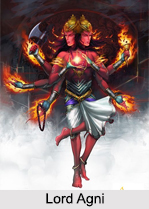
In Hari Vans, Agni is dressed in black and has smoke all around him. He is revealed to have four hands, and drives a chariot with four red horses. When Agni is symbolized in a humanoid appearance, he is shown to have two faces, which are grimy with butter, to give fuel to the flame.
He has seven fiery tongues and sharp golden teeth. He has black, long hair and is red in colour. Seven rays of light come out from his body and he has seven hands with three legs. He is often shown to be riding a chariot either pulled by rams or goats, or sometimes he rides parrots. He is depicted as having two heads. One head signifies immortality, and the other is a representation of life.
Legends of Lord Agni
Lord Agni has been worshipped by the Hindus since the Vedic period. Agni Purana is named after him. Before the appearance of Lord Shiva as the god of Hindu trinity, Lord Agni was the God of destruction. The Vedic hymns pay tribute to him profusely, often describing him as the absolute God and originator. He is the thunderbolt of Lord Indra`s weapon, the light of the Lord Surya. In the later Vedic period, he became one of the "Ashtadikpalas" as lord of the southeast area.
Once, Lord Agni had insulted sage Bhrigu, who cursed him to become the devourer of everything. Scared of this curse, Lord Agni went to Lord Brahma and requested him to do something. Therefore Lord Brahma changed the curse in such a way that Lord Agni became the purifier of all the things he touched. It is said, that when people use fire, they should use it in different ways. He is said to be the protector of the south east direction. He gives out the light of awareness and leads people to the course of reality.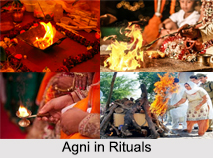
Forms of Lord Agni
Agni is said to have ten forms and these are as follows:
•The ordinary fire
•Lightning
•The sun
•The digestive fire
•Destructive Fire
•Absorbing fire
•Fire yielded through sticks used for sacrifices and rituals
•Fire given to a student during his "Upanayana" ceremony
•Domestic fire
•Southern fire of ancestors
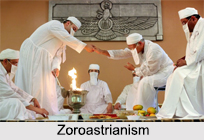
Vedic ceremonies involve Lord Agni. He is a part of several Hindu rites-of-passage ceremonies such as celebrating a birth, prayers, weddings, and at death. Agni is representation for emotional and physiological aspects of life. There are three kinds of Agni inside every human being, the "krodha-agni" or "fire of anger", the "kama-agni "or "fire of passion and desire", and the "udara-agni" or "fire of digestion". Agni is the spirit of the knowledge of continuation.