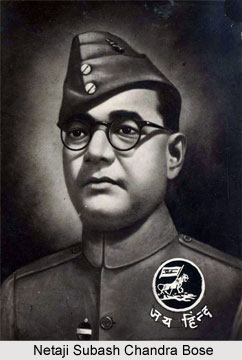
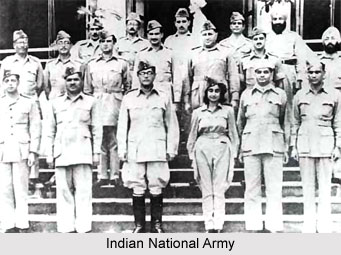
 Indian National Army, also known as the Azad Hind Fauj, was formed for the liberation of India from the British rule. It was formed in South-East Asia in the year 1942 by pioneering Indian Nationalists and prisoners who wanted to throw off the yoke of foreign domination and liberate the country. The INA was initially formed under Mohan Singh, after the fall of Singapore, the captain in the 1/14th Punjab Regiment in the British Army. However, the first INA under Mohan Singh collapsed and finally it was revived under the leadership of Subash Chandra Bose in 1943. Bose`s army was declared as the Azri Hukumat e Azad Hind. Indian National Army emerged along with Mahatma Gandhi`s peaceful resistance movement within India. In contrast to Mahatma Gandhi, Bose advocated a more aggressive confrontation with the British authorities.
Origin of Indian National Army
INA was formed during the first world war when the Ghadar Party and the emergence form of the Indian Independence League planned to rebel in the British Indian Army from the Punjab through Bengal to Hong Kong. However, this plan met with failure after the information was leaked to British Intelligence. During the Second World War, the plan to fight the British found revival and a number of leaders and movements were initiated. These included the various "liberation armies" which were formed in as well as with the help of Italy, Germany as well as in South-east Asia. Thus in South East Asia the concept of the Indian National Army emerged. It was supported by the Japanese 15th army and led by Bose.
Composition of the Indian National Army
Indian National Army had many valued freedom fighters that helped in the battles. They all had a brilliant background and fought for a similar cause, freedom of India. The INA freedom fighters were from every sphere ranging from barristers to plantation workers. The revival of the Indian National Army was done by Subhash Chandra Bose. In 1943 he
Training in the Indian National Army
Most of the people who joined the army had no prior military experience and thus to ensure a well-trained army, Bose established an Officers Training School for INA officers and the Azad School for the civilian volunteers Many youth were also sent to the Imperial Military Academy in Japan for advanced training. Every soldier was required to spend about six to eight hours of training daily. The training included physical training, army drill and handling arms such as rifles, pistols, hand grenades and bayonets. The soldiers also attended lectures of Indian and world history and military subjects like map reading as well as signalling.
 Battles of Indian National Army
The battles that were fought by the Indian National Army during World War II were fought in the South-East Asian region. The operations include Malayan Campaign in 1942 as well as Burma Campaign. The operations of the INA involved the battle of Imphal, Kohima, Pokoku and Irrawady River operations. It began a long march over land and on foot towards Bangkok, along with Subash Chandra Bose. At the time of Japan`s surrender in September 1945, Bose left for Manchuria to attempt to contact the advancing Soviet troops, and was reported to have died in an air crash near Taiwan. On the other hand the INA fighters were imprisoned. The prisoners faced the death penalty, life imprisonment or a fine as punishment if found guilty.
Women in Indian National Army
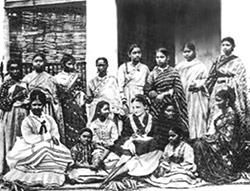
Indian National Army was structured in a way that lodged active participation from women. A women regiment was formed in 1943. INA had John Thivy, Dr. Lakhsmi Sehgal, Narayan Karruppiah as well as Janaki Thevar as its members. Among the masses attending Bose`s rally on 9 July, Dr. Lakshmi, responded immediately to his appeal to form a Women`s Regiment. She visited many families to persuade the women to join the INA. Many were reluctant; however, she managed to gather twenty enthusiastic girls who were willing to break the traditional barriers. The girls presented the guard-of-honour to Bose. He was impressed and invited Dr. Lakshmi to lead the Women`s Regiment. On 12 July 1943, Bose announced the formation of the Women`s Regiment, naming it "Rani of Jhansi Regiment" which in later years was considered to be a special characteristic of the INA.
INA fighters were not invited to join the Indian Army after India`s independence. However, a few ex-INA members later have seen prominent public life or held important positions in independent India.
The Indian National Army thus rose to power under the able leadership of Bose. Though it was ultimately disbanded, its heroic attempts at forming an army and taking a radical step towards Indian Independence marked a significant step in the Indian Independence Movement.