


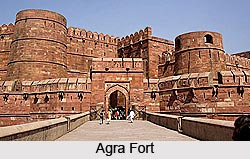
 Agra Fort is located on the right bank of the Yamuna River in the city of Agra in Uttar Pradesh. The construction of this massive structure began in 1565, under Akbar, and continued till the time of his grandson, Shahjahan, when it changed from a principally military structure to a more luxurious palace. This red sandstone fortress encompasses the imperial city of the Mughal emperors, within its 2.5km long enclosure walls. It is one of the most important and robustly built strongholds of the Mughals, embellished with number of richly decorated buildings encompassing the imposing Mughal style of art and architecture. The fort can be more accurately described as a walled city. Agra Fort is located on the right bank of the Yamuna River in the city of Agra in Uttar Pradesh. The construction of this massive structure began in 1565, under Akbar, and continued till the time of his grandson, Shahjahan, when it changed from a principally military structure to a more luxurious palace. This red sandstone fortress encompasses the imperial city of the Mughal emperors, within its 2.5km long enclosure walls. It is one of the most important and robustly built strongholds of the Mughals, embellished with number of richly decorated buildings encompassing the imposing Mughal style of art and architecture. The fort can be more accurately described as a walled city.
It was constructed on the remains of an ancient site known as Badalgarh. The fort has survived through the onslaught of time, nature and men. The fort spreads over an area of about 94 acres of land. At present, there exist more than two dozens of monuments in the Fort. Abul Fazl, a court historian of Akbar, records that 5000 buildings were built here beautifully in Bengali and Gujarati style. 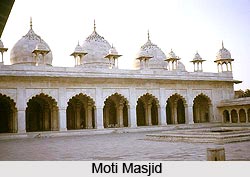 Armed with massive double walls and punctuated by four gateways, thMost of these buildings have now disappeared. Later, the British destroyed most of the buildings for raising barracks. Hardly 30 Mughal buildings have survived on the south-eastern side. Of these, the ‘Delhi Gate’, ‘Akbari Gate’ and ‘Bengali Mahal’, are representative of buildings raised during the reign of Akbar.e fort houses palaces, courts, mosques, baths, gardens and gracious pavilions within its premises. This fort blends the Hindu and central Asian architectural styles very beautifully. Thus, being an excellent example of Mughal architecture, the Agra Fort is one of the few UNESCO World Heritage Sites in India. Armed with massive double walls and punctuated by four gateways, thMost of these buildings have now disappeared. Later, the British destroyed most of the buildings for raising barracks. Hardly 30 Mughal buildings have survived on the south-eastern side. Of these, the ‘Delhi Gate’, ‘Akbari Gate’ and ‘Bengali Mahal’, are representative of buildings raised during the reign of Akbar.e fort houses palaces, courts, mosques, baths, gardens and gracious pavilions within its premises. This fort blends the Hindu and central Asian architectural styles very beautifully. Thus, being an excellent example of Mughal architecture, the Agra Fort is one of the few UNESCO World Heritage Sites in India.
Construction of the Agra fort The construction of the Agra fort started in 1565, when the initial structures were built by the Mughal Emperor Akbar and subsequently taken over by his grandson Shah Jahan. Later on, he added most of the marble creations to the fort. The layout of the fort was determined by the course of the river, which flowed alongside in those days. The main axis is parallel to the river and the walls bridge out towards the city. The fort is crescent shaped, flattened on the east with a long, nearly straight wall facing the river. Double castellated ramparts of red sandstone, punctuated at regular intervals by bastions, ring it. A 9m wide and 10m deep moat surrounds the outer wall. An imposing 22m high inner wall imparts a feeling of invincible defensive construction. 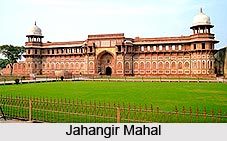
The well-shaped stones are linked by iron rings. It has two big ornamental gateways, one each on its southern and western sides. There is a moat filled with water around the fort in order to ward off enemies. The fort originally had four gates, two of which, were later walled up. Today, visitors are allowed entry only through the Amar Singh gate. The Jahangir Mahal is the first notable building that is visible to the visitors, as they enter through the Amar Singh gate. Akbar built Jahangir Mahal as the women’s quarters. It is built of stone and is simply decorated on the exterior. Ornamental Persian verses have been carved on a large stone bowl, which were probably used to contain fragrant rose water. Other places near Agra Fort Among the fascinating structures that are to be found within the fort is the Moti Masjid, which is a white marble mosque similar to a perfect pearl. Then, there is also the red sandstone Jahangiri Mahal built by Akbar for his Hindu queen, Jodhabai. The Diwan-i-Am, the Diwan-i-Khas, Khaas Mahal, Sheesha Mahal-the Palace of Mirrors, the Pearl mosque, the Nagina Masjid, the Garden of Grapes, the Fish Pavilion and the Musamman Burj - where Mughal Emperor Shah Jahan died in 1666 A.D., are the other monuments in the fort complex. Shah Jahan has built the "Khass Mahal", which is made entirely of marble. It demonstrates distinctive Islamic-Persian features. 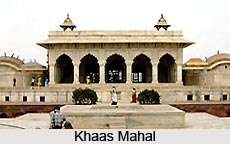 These are well blended with a striking range of Hindu features such as "Chhatris". It was supposed to be the emperor's sleeping room or ‘Aramgah’. The Khaas Mahal provides the most successful example of painting on a white marble surface. These are well blended with a striking range of Hindu features such as "Chhatris". It was supposed to be the emperor's sleeping room or ‘Aramgah’. The Khaas Mahal provides the most successful example of painting on a white marble surface.
On the left of the Khaas Mahal, is the "Musamman Burj", built by Shah Jahan. It is a beautiful octagonal tower with an open pavillion. It boasts of its openness, elevation and cool evening breezes. This is where Shah Jahan lay on his deathbed, gazing at the Taj. Sheesh Mahal or the Glass Palace is the finest example of decorative water engineering in the hamams. It is believed to have been the harem or the dressing room and its walls are inlaid with tiny mirrors. These are the best specimens of the glass-mosaic decoration in India. 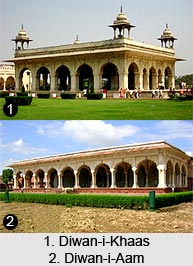
To the right of Sheesh Mahal is the "Diwan-I-Khaas", the hall of Private Audience. The marble pillars are inlaid with semi-precious stones in delightful floral patterns. The "Diwan-I-Am" used to house the famous Peacock Throne, which was taken to the Red Fort when Shahjahan moved his capital to Delhi. The throne alcove is of richly decorated white marble. "Nagina Masjid", built by Shahjahan, was the private mosque of the ladies of the court. "Moti Masjid" or the Pearl Mosque is the prettiest structure at Agra Fort. The building is presently closed for visitors. Near Moti Masjid is "Mina Masjid", which seems to have been constructed by Shahjahan strictly for his private use. |
| |||



Home > Art & Culture > Indian Monuments > World Heritage Monuments in India > World Heritage Monuments in North India > Agra Fort
Agra Fort
| The Fort in Agra, Uttar Pradesh, is built of red sand stones & is an excellent example of Mughul architecture. |
| ||||||||||||||||||||||||||||

