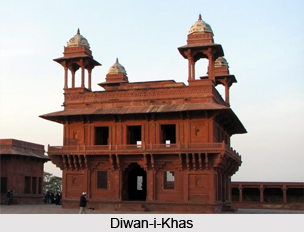
 Fatehpur Sikri can majestically be stated as that insignia of Mughal Emperor Akbar, who literally had risen to yet enough elevated status in the eyes of his subjects. The fort, besides serving to the royal household and regal visitors to the everyday court of Akbar, was also a declared gift to the common man, who were bestowed with a city within Fatehpur Sikri itself! Begun in the most flourishing period of Akbar`s reign in 1570, Fatehpur Sikri, bears every kind of excellent instance that ever a man can conceive and comprehend it further. However, with all its legendary glory and alluring elaborations, Fatehpur Sikri is also that seat which holds the most significance in economical and administrational transactions during the Mughal era of Akbar. As such, with edifices like Diwan-i-Khas for the most intimately welcomed courtiers, Akbar was legendary to have been hugely in style amongst such group of men. Diwan-i-Khas, just like Fathepur Sikri`s other esteemed and prized architectures, holds adequate honourableness for the mass as well the class.
Of all the buildings in Fatehpur Sikri, a small square building commonly and respectably acknowledged as the Diwan-i-Khas, has remained the subject of greatest speculation. The monument`s location, situated just behind the Public Audience Hall (referring to the Diwan-i-Am) and aligned with the jharoka, indicates very much that this was the Private Audience Hall. The exterior of Diwan-i-Khas fits well with the other trabeated palace pavilions in Fatehpur Sikri; its interior, however, is unique. There exists the centre of the building`s single chamber is an elaborately carved faceted pillar, reaching approximately half of the building`s summed height. The Hall`s capital is framed of serpentine brackets, reminiscent of those appearing in the Delhi Sultanate architecture of Gujarat, Mandu and `Lodi Delhi`. These brackets, fuller at the top than at the bottom, defend a circular platform. It is attached to each corner of the building by stone slab walkways, connected to the building`s corners. A narrow path circumscribes the structure connecting the walkways of the highly charged Diwan-i-Khas of Fatehpur Sikri.
It is quite a topic of lore and loved speculation that Akbar probably sat upon this central platform being talked about in Diwan-i-Khas. As such, some believe that in this platform the emperor had projected himself as a chakravartin, or universal ruler, following the indigenous Indian notions of kingship; however, since Akbar`s deep interest in Hinduism and other non-Islamic traditions developed after much of Fatehpur Sikri was well under construction, this theory can also be viewed as being tentative. More likely, Akbar had sat on this central platform to project himself as the dominant figure in the Mughal state, its `axis` and the `pillar` of its support.