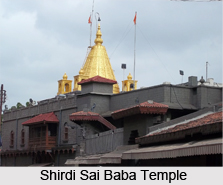
 Shirdi Sai Baba Temple is the very famous and renowned temple of Shri Sai Baba. The temple is situated in Rahata Tehsil in Ahmednagar District of Maharashtra. It was establishes in 1922, to carry out services in honour Shri Sai Baba. Sai Baba has the unique power of attracting followers from the lower and higher levels of society alike. The spot where he attained enlightenment is where the present temple has been built. He was and is still worshipped as "God".
History of Sai Baba
Considered to be the incarnation of the Almighty, Sai Baba was an ordinary "fakir" or beggar, who preached the meaningful teachings of God. He started showing peculiar miracles at a very young age, though leading a very simple life. These incidents increased day by day and soon he began to be regarded as "A Man with Extraordinary Powers".
Infrastructure of Shirdi Sai Baba Temple
Shirdi Sai Baba Temple is divided into several parts, owing to the vastness of its complex. They comprise; "Samadhi Mandir", "Dwarkamai", "Gurusthan" and "Lendi Baugh".
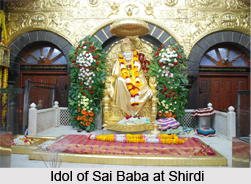
"Samadhi Mandir" of Shri Sai Baba was originally owned by a millionaire from Nagpur, a renowned devotee Shreemant Gopal Rao. Gopal Rao wished to keep an idol of Murlidhar (Lord Krishna) here. However, Baba himself transformed himself into Murlidhar, and the Mandir became the Samadhi of Baba. The entire mandir is built with stones and Baba"s Samadhi is built especially with white marble. A girding is built in marble covering the Samadhi and it is decked with ornamental decorations. In front of the Samadhi are 2 silver pillars with intricate decorations. Just behind the Samadhi is Sai Baba"s splendid statue of Italian marble that denotes him in a seated position atop a throne. Above the statue is an open silver umbrella. The front of the mandir has an assembly hall where about 600 devotees can be accommodated. The numerous items used by Baba are kept here, for general viewing. The first floor of the mandir has pictures depicting the life of the Baba.
"Dwarkamai" is the place where Shri Sai Baba stayed on till the end of his life. It is situated on the right side of the Samadhi Mandir. In Dwarkamai he cured people of their sickness, worries and other problems. Before the advent of Baba, the place was a dilapidated mosque. He turned it into Dwarkamai and stated to people that "God" is one. The first level of Dwarkamai has a portrait of Baba and a big stone on which Baba used to sit. This level has 2 rooms, one containing the chariot and the other a palanquin. Just in front of the room where the chariot is kept, there is a small temple. A saffron flag flies on top of it. The second level of Dwarkamai has a square stool made of stone, which was used by Baba for his bath. The chief attraction here is the oil painting of Shri Sai Baba seated on a carved wooden shrine. The level also has the grinding stone and the wooden vessel called "Kolamba" in which Baba used to keep the "Bhiksha" (alms) brought from the villagers.
 "Gurusthan" is the place where Sai Baba was first spotted seated under a Neem tree. Baba had come here when he was a "Bal Yogi", a child ascetic. A small shrine adorns the Gurusthan, on an elevated platform of which a huge portrait of Baba is kept. On its side is a marble statue of Baba can be witnessed. In front of the portrait are a Shivling with the Nandi; photos of 12 Jyotirlingas are also kept inside the temple. At a short distance lies the "Chavadi" of Baba. He used to sleep here every alternate day. The Chavadi is divided into two parts- one part of the Chavadi has a large portrait of Baba along with a wooden bed and a white chair belonging to him.
At some distance from Gurusthan there is the "Lendi Baugh". This baugh (garden) was watered and taken care of by Sai Baba himself. It got its name from a drain that previously flowed there. Baba used to visit this place every morning and afternoon to take rest under a Neem tree. He had dug a huge pit, 2 feet deep and kept an oil lamp lit in the pit. An octangular Deepgriha called "Nanda Deep" has been built in marble, in memory of this tiny place. At the entrance of the Baugh, are the Samadhis of staunch Sai Baba devotees Tatya Kote Patil, Bhau Maharaj Kumbhar, Nanavalli and Abdul Baba.
Celebrations at Shirdi Sai Baba Temple
Daily routine of the temple starts at 5.00 a.m. with "Bhoopali", a morning raga sung in the morning, and closes at 10 PM in the night after "Shejarati" is sung. Only on 3 occasions the temple is kept open overnight, on "Guru Purnima", "Dussehra" and "Ramnavami". Every evening at 6.30 p.m. the main "Aarti" starts for Sai Baba. Devotees from far and near sing hymns in praise of the lord. The sacred ash of Sai Baba, "Vibhuti" is distributed amongst the worshippers for offerings. Thursday is regarded the special day for Sai Baba, as million of devotees throng to the temple.
How to Reach Shirdi Sai Baba Temple
Shirdi is located approximately 296 km from Mumbai. The nearest railway station is Kopargaon, 15 km on the Manmad-Daund section of Central Railways.