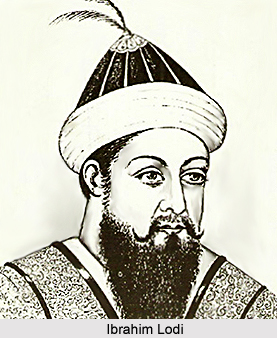
 Ibrahim Lodi ascended the throne after the death of his father Sikandar Lodi. He was the last ruler of the Lodi dynasty as well of the Delhi Sultanate. Ibrahim Lodi ruled over a wide part of India from 1517 to 1526. He was defeated by the Mughal leader Babur in the battle of Panipat, who then established new Mughal dynasty in Delhi that would last for three centuries. Ibrahim Lodi had to face many rebellions during his rule.
The most notable feature of the reign of Ibrahim Lodi was his conflict against the Afghan nobility. Ibrahim desired to conquer Gwalior which had defied such attempts by the previous Sultans of Delhi including Sikandar Lodi. Ibrahim sent a large army under Azam Humayun Sarwani to attack Gwalior and another army was sent for his support from Agra and finally Gwalior was annexed to the Delhi Sultanate. Ibrahim failed in his attempt to conquer Malwa and Mewar and lost prestige and resources.
Ibrahim Lodi was a capable, laborious, just and well-meaning Sultan. He honestly desired the welfare of his subjects and succeeded in it. His subjects remained prosperous and contented under his rule. Thus, as a ruler, he proved himself equal to his father and grandfather. He was courageous, a dauntless soldier and a successful commander. In 1525 A.D. when Daulat Khan Lodi and Alam Khan Lodi attacked Delhi they succeeded in destroying the main army of the Sultan, yet, Ibrahim stayed back in the field only with his body-guards and when, in the morning, he found the enemy soldiers busy in plunder he attacked them and forced them to flee. It was a rare daring act on the part of the Sultan. He did not even withdraw himself from the battle of Panipat and died fighting.
There were also certain flaws on his part. He was rash and impolitic. He failed to comprehend the character and sentiments of his own race. He decided to crush the power of his nobility and remained adamant on it till end. He failed to follow that his Afghan nobles could compromise their self respect and spirit of independence only gradually. They were gradually learning to respect the Sultan because of the tactful policy of his father. Ibrahim only needed to follow further the same policy. On the contrary, Ibrahim provoked their rebellious temperament by attacking their self-respect and position of power. He lost many opportunities to compromise with them due to his adamant nature. It resulted in a direct conflict between the Sultan and his nobles which certainly weakened the empire.
The problem intensified when Ibrahim Lodi replaced the old and senior nobilities with the young ones, who were loyal to him. His subjects also feared and abhorred him. The displeased nobilities of Ibrahim Lodi eventually invited Babur of Kabul to attack and invade India. In the first battle of Panipat Ibrahim Lodi had superior number of troops with him but Babur`s fighters were superior in quality as well as many of the Lodi`s soldiers deserted him. Thus it led to Ibrahim Lodi`s downfall and he was killed in the battle on April 21, 1526.