History of Mizoram is mysterious. Their history is marked by a series of raids and expeditions.
Early History of Mizoram
It is said that the Mizos came from Shinlung or Chhinlungsang, which is believed to be the Chinese city situated close on the Sino-Burmese border. They first settled in the Shan area and lived there for about 300 years and then moved to the Kabaw Valley around 8th century. It was here that the Mizos got an opportunity to interact with the local Burmese. The two cultures met and influenced each other in the fields of clothing, sports and music. It is said that from here the Mizos learnt the art of cultivation. From Kabaw they came to Khampat. The areas they claimed here were encircled by a clay wall and were divided into several parts. It is said that, they planted a banyan tree before they left Khampat as a sign that town was made by them. There were political turmoil`s in China in 210 B.C. and when the dynastic rule was abolished and the whole empire was brought under one administrative system. Rebellions broke out and the Mizos left China as part of one of those waves of migration.
 Medieval History of Mizoram
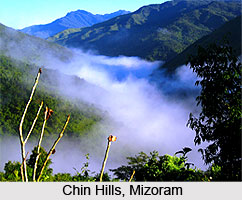
In the 14th century the Mizos settled at the Chin Hills on the Indo-Burmese border. They built villages and called them by their clan names such as Seipui, Saihmun and Bochung. The hill and difficult terrain of Chin Hills stood in the way of the building of another central township like Khampat. The villages were scattered that it was not possible for the various Mizo clans to keep in touch with one another. They finally moved across the river Tiau to India in the Middle of the 16th Century. The Mizos who earlier migrated to India were known by the name Kukis. The last of the Mizo tribes to migrate to India were the Lushais.
History of Mizoram during British Raj
The Mizo Hills were declared as part of British India in 1895. The areas including Lushai Hills were declared as backward tracts. It was during the British rule that there was a political awakening among the Mizo and as a result in 9th April 1946, the first political party, the Mizo Common People`s Union was shaped. The party was later renamed as Mizo Union. The Constituent Assembly started an Advisory Committee to deal with the problems of the minorities and the tribals. A sub-committee was formed to advice the Constituent Assembly on the tribal affairs. The Mizo Union submitted a declaration demanding the inclusion of all Mizo inhabited areas adjacent to Lushai Hills. Nevertheless, a new party called the United Mizo Freedom (UMFO) came up demanding that Lushai Hills be joined Burma after Independence. The Government under the suggestion of the Bordoloi Sub-Committee allowed a certain amount of Independence. This suggestion was enshrined in the sixth schedule of the Constitution.
History of Mizoram during Post-Independence Period
In 1952, The Lushai Hills Autonomous District Council was formed which lead to the abolition of chieftainship in Mizo society. The autonomy met the objectives of the Mizos only partially. In 1954, the representatives of the District Council and the Mizo Union appealed with the States Reorganization Commission (SRC) in for integrating the Mizo-dominated areas of Tripura and Manipur with their District Council in Assam. The tribal leaders were unhappy with the suggestions of the SRC. As a result they met in Aizawl and formed a new political party called the Eastern India Union (EITU) and raised the demand for a separate state.
The tribal leaders in the North East were laboriously unhappy with the SRC suggestions. They met in Aizawl in 1955 and formed a new political party, Eastern India Union (EITU) and raised demand for a separate state comprising of all the hill districts of Assam. The Mizo Union split and the separated faction joined with the EITU. By this time, the UMFO also joined the EITU and they demanded for a separate Hill state. Therefore, it seems that the Mizos moved from China to Burma and then to India under forces of circumstances.