
Known to have essentially descended from the Brahmi script, Gupta script comes under the category of Northern Indian group of scripts. The script had evolved with the rise of the Gupta Empire in India in the earlier periods of 4th to 6th centuries A.D. After the invasion of the plundering Huns, Gupta script witnessed a loss in its novelty. In spite of all such drawbacks and hindrances, it continued to develop in the next few centuries and by the 8th century umpteen versions of the script emerged, two of which are Nagari and Sarada. The script involving the Gupta rulers, is written fundamentally in the direction from left to right and later gave rise to the Siddham script. Gupta script, also referred to as Gupta Brahmi, was used for writing Sanskrit and Sanskritic verses and prose. The period of ruling of Gupta Empire in India was a period of materialistic affluence and opulence, coupled with immense religious and scientific maturations.
In contemporary times, scholars and scientists have at times modified the aboriginal Gupta script to signify syllables instead of single sounds. Gupta script`s popularity and spreading to common masses over extensive areas of conquered territory time and again reverberates back to Gupta dynasty and its exceedingly intelligent and gifted rulers, with the result that the Gupta alphabet was the ancestor (for the most part by means of Devanagari script) of most later Indian scripts.
The original Gupta alphabet from the aboriginal script possessed 37 letters, together with 5 vowels. Four principal subtypes of Gupta script developed from the original alphabet: eastern, western, southern and Central Asian. The Central Asian Gupta can be further divided into Central Asian Slanting Gupta and its Agnean and Kuchean variants and Central Asian Cursive Gupta, or Khotanese. A western offshoot of eastern Gupta gave rise to the Siddhamatrka script (c. A.D. 500), which, in turn, developed into the Devanagari alphabet (c. A.D. 700), the most prevalent of the modern Indian scripts. A northern form of Brahmi further evolved into the Gupta scripts, from which were descended the Tibetan and Khotanese systems. Khotanese was however also influenced by the Kharosthi script. Historic theories also state that Gupta script were the prototypes of the North Indian subdivision of the Brahmi script from the 1st centuries B.C. and A.D.
Gupta script
The Gupta script, which is derived from the Brahmi script, gave rise to the Siddham script.
Recently updated articles in History of India
Suhungmung
Suhungmung was the fourteenth ruler of the Ahom dynasty who ruled from the period 1497 to 1539 AD. His reign was significant in terms of expansion of...

Princely State of Dadhalia
Princely State of Dadhalia was located in the present state of Gujarat. The state covered a total area of 28 sq miles and comprised of 15 villages. Th...
Princely State of Rupal
Princely State of Rupal was a part of the Baroda Agency, a sub division of Western India States Agency. It was under the administrative control of the...
Archaeological Sites of West Bengal
Archaeological sites of West Bengal reveal several aspects of ancient India. Excavations by the Archaeological Survey of India have furnished artefact...

Princely State of Gabat
Princely State of Gabat was one of the native states of India during the Brtish period. Thakors were the native rulers of this state. After India gain...
Related articles in History of India

Mughal Architecture during Babur
Mughal architecture during Babur marked the foundation of a new architectural era in India, blending Timurid, Persian, and local influences. His reign...
Architecture during Sayyid and Lodi Dynasty
Architectures during the Sayyid and Lodi dynasty were mainly the tombs and monuments for the dead rulers. It were carefully designed and meticulously...

Brahmanical Sources of Ancient History
Brahmanical Sources of ancient history are contained in the Vedas and they constitute one of the most important literary sources of information about...
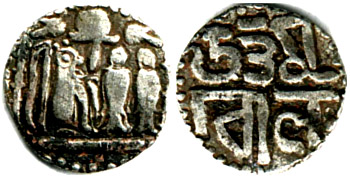
Coins of Chola Empire
Coins of Chola Empire were issued in gold, silver and copper and carried the Chola emblem.
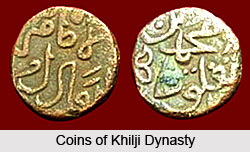
Coins of Khilji Dynasty
Coins of Khilji Dynasty had an influential feature that was followed by the other dynasties.