





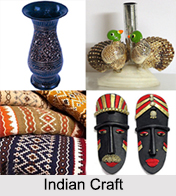
 Indian Crafts are known throughout the world for their artistic work and grandeur. The deeply entrenched tradition of Indian Craft echoes the true colour of India whilst impressing generation after generation amidst their varied forms and styles. For people around the world, India is synonymous to exotic arts and handicraft traditions. A wide range of traditional Indian craft reflects the richness of Indian ethnic art and culture. The designs and finishes represent the excellent artistic skills of the craftsmen. Indian Crafts are known throughout the world for their artistic work and grandeur. The deeply entrenched tradition of Indian Craft echoes the true colour of India whilst impressing generation after generation amidst their varied forms and styles. For people around the world, India is synonymous to exotic arts and handicraft traditions. A wide range of traditional Indian craft reflects the richness of Indian ethnic art and culture. The designs and finishes represent the excellent artistic skills of the craftsmen.
Indian Craft tradition has no parallel in the world, in diversity as well as in technique and use of materials. The craft traditions of India vary from region to region. These crafts not only cater to the day-to-day needs of the people but are also used for decorative and religious purposes. Origin of Indian Craft Indian Craft thrive to be the amalgamation of socio-political via religious influences that mapped India with the onward march of time and space. The spirit of indigenous India allied with the western advancement lie at the core of Indian Craft zone. The intriguing history and the fascinating past presently counts for the origin of Indian Crafts. The tradition of Indian craft has whirled around religious values, cultural influx, confined needs of the commoners, as well as the special needs of the clientele and royalty, along with an eye for overseas and home trade. Indian Craft is an enigma of arts and science; the art requiring talent and technique, and science relying on the knowledge within. History of Indian Craft The history of Indian Craft owes to one of the established civilizations of the globe while dating back to almost 5000 years from present. The primal references of Indian crafts were found in the remnants of Indus Valley Civilization (3000 B.C. – 1700 B.C.). The Indus valley civilization is abundant with numerous examples of crafts of ancient times. Beginning its journey in the age old days, the craft tradition in India has witnessed enough evolution. 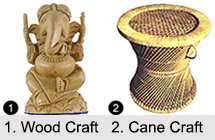 Development of Indian Craft Development of Indian Craft
Pre-historically Indian handicrafts were basically made for day after day use, the yearning for aesthetic application soon saw development of flooding designs and motifs. Indian textiles, permanent dyes had their far flung supremacy in ancient India; silk was exported from India to Europe in the 6th century A.D. Mughal era witnessed the patronage of brilliant artisans and craftsmen endowed with magical bliss and as a result Mughal carpets, ivory-bones-horns cravings and papier mache. Akbar, Shah Jahan, Jahangir invited the skilled artisans from all over the globe. With them breezed in their native art forms and Indian handicrafts sojourned to its pinnacle of perfection. The disintegration of the Mughal Empire even led to the rapid down fall in the craft industry as the later lost its powerhouse of patronage. Later, with the East India Company engaging in trade with India, Indian crafts were ousted, and decreased in volume. Indian markets were flooded with machine made goods from Europe. Later Swadeshi movement under Mahatma Gandhi's able leadership adhered to the dawn of reawakening for the plight of Indian craftsmen. 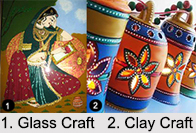 Forms of Indian Craft Forms of Indian Craft
Each states of India had its own tradition and legacy of handicrafts. Whether the fragile beauty of the Phulkari art of the North India or the dizzying artistry of the silver filigree work, famous in the eastern India, whether the colossal impact of the stone craft of South India or the artistry of the bidriware of the western India - all demonstrates the elegance and brilliance of Indian Craft. From pottery, metal craft, woodcraft, stone works, gems and jewellery, textiles, leatherwork to paintings and sculptures and statues - India has perfected almost all the arts and handicrafts known to humanity. The types of Indian crafts are varied each standing as the logo of the rich Indian heritage. Be it the sheer brilliance of the brocades of Varanasi or the warmth of the Kullu shawls of Himachal Pradesh; be it the elegance of the namdhas of Kashmir or the artistry of the meenakariand kundan works, the charm and originality of each Indian craft reverberates the heritage of India, unaltered by time. Indian crafts never fail to charm the world with their beauty and wonder. Rural communities of India still hold the cultural tradition of crafts guarded with sincerity. Indian craft amidst their elegance, brilliance and originality thus symbolizes the very essence of India whilst reflecting its rich heritage. |
| ||||||||||||||||||||||||||||

