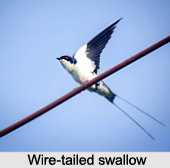
 Wire-Tailed Swallow is a small bird of passerine family and it is an Indian bird that bears a scientific name of "Hirundo smithii". The Asian form of Wire-Tailed Swallow is found in southern Uzbekistan south through Tajikistan, Afghanistan, Pakistan, India east to south-western Nepal, Burma (Myanmar), northern Thailand, Laos, Cambodia and central Vietnam.
Category of Wire-Tailed Swallow
Wire-Tailed Swallow has two subspecies: H. S. smithii, which occurs throughout Africa, and H. S. filifera, which is found in southern and south-eastern Asia. It is mainly resident, but populations in Pakistan and northern Indian state like Jammu and Kashmir, Himachal Pradesh, Uttar Pradesh migrate further move south in winter season.
Habitat of Wire-Tailed Swallows
Wire-Tailed Swallow is found in open country near water and human habitation. Wire-Tailed Swallows are fast flyers and they generally feed on insects, especially flies, while airborne. They are typically seen low over water, with which they are more closely associated than most swallows.
Nests of Wire-Tailed Swallow
The neat half-bowl nests of Wire-Tailed Swallow are lined with mud collected in the swallows` beaks. They are placed on vertical surfaces near water under cliff ledges or more commonly on man-made structures such as buildings and bridges.
Eggs of Wire-Tailed Swallow
The clutch of Wire-Tailed Swallow is three to four eggs in Africa, up to five in Asia (Turner and Rose). These birds are solitary and territorial nesters, unlike many swallows, which tend to be colonial.
Size of Wire-Tailed Swallow
Wire-Tailed Swallow is a small swallow, measuring 18 cm in length. It has bright blue upperparts, bright white under parts and a chestnut cap. Immature birds lack tail wires, and have dull brown (rather than chestnut) caps. The plumage of Wire-Tailed Swallow is mostly bright blue above, except for the reddish-brown crown (top of the head) and white spots on the tail. There is a blue bar extending from the beak through the eyes down to the neck and back. The plumage below is white, except for the darker flight feathers.
Behaviour of Wire-Tailed Swallow
Wire-Tailed Swallows are mostly resident that is they are non-migratory in nature, except for some populations in Pakistan and northern part of India that migrate south for the winter.