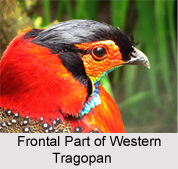
 Western tragopan or western horned tragopan, with a scientific name "Tragopan melanocephalus" is a medium-sized brightly plumed pheasant found along the Indian Himalayas from Hazara in northern Pakistan in the west to Uttarakhand within India to the east. The species is highly endangered and globally threatened.
Western tragopan is considered the rarest of all living pheasants. Its range is very restricted. In Kullu District of Himachal Pradesh, this bird is locally called jujurana. It was accorded the status of state bird of Himachal Pradesh in 2007.
Structure of Western Horned Tragopan
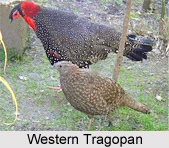
The male Western Horned Tragopan is very dark, grey and black with numerous white spots, each spot bordered with black and deep crimson patches on the sides and back of the neck. The throat is bare with blue skin while the bare facial skin is red. They have a small black occipital crest. Females have pale brownish-grey upper parts finely vermiculated and spotted with black, and most of the feathers have black patches and central white streaks. Immature males resemble females, but are larger with longer legs and a variable amount of black on the head and red on neck.
Genders of Western Horned Tragopan
The males weigh 1.8-2.2 kg (4.0-4.9 lb) and females weigh 1.25-1.4 kg (2.8-3.1 lb). The males vary in length from 55-60 cm (22-24 in) while the females are 48-50 cm (19-20 in).
Concentration of Western Horned Tragopan
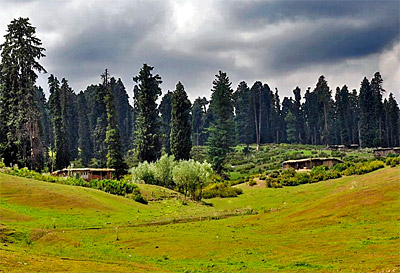
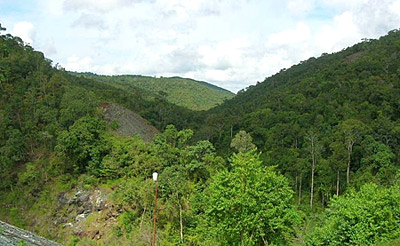
The five populations are known from Kohistan, Kaghan valley, Kishtwar, Chamba, Kullu and an area east of the Sutlej River. They are found from an altitude of 1,750 to 3,600 m, going higher in summer. Their preferred habitat is the dense under storey of temperate, sub alpine and broad-leaved forest.
Climatic Capacity of Western Horned Tragopan
Western Horned Tragopan inhabits upper temperate forests between 2,400 and 3,600 m in summer, and in winter, dense coniferous and broad-leaved forests between 2,000 to 2,800 m elevations. Western Horned Tragopan is mostly arboreal but feeds on the ground. They feed mostly on leaves, shoots and seeds, but also consume insects and other invertebrates. Like most pheasants, they roost in trees singly or in pairs except during nesting.
Population of Western Horned Tragopan
The population of the western tragopan is threatened by several anthropogenic factors throughout its range. The world population is estimated at fewer than 5,000 individuals, including a captive population of fewer than five at the moment.