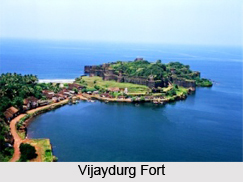
 The fortress of Vijayadurg is one of the most imposing in the area. Also known as Viziadurg, it is situated about 30 miles to the South of Ratnagiri, Maharashtra. Vijayadurg has one of the best harbours and most interesting sea-forts on the West Coast of India.
Vijayadurg was earlier known as Girye or Gherya as it is surrounded by water on three sides. It stands on a rocky projection and rises at a grand height of almost 100 feet from the Vaghotane River. The site of the fort is a rather old one, first enlarged by the rulers of the Bijapur dynasty and later by Chhatrapati Shivaji. It existed as a dilapidated fortification under the Shilahar dynasty till it was taken over by the rulers of the Bijapur kingdom. It was Shivaji who decided, after failing to capture the Murud Janjira, to create the Vijaydurg as a stronghold. In the mid-17th century, Shivaji introduced a triple line of fortifications, towers and massive inner buildings to Vijayadurg.
Vijaydurg has been known to put up a strong defense against a number of powers who tried to seize it. Angre, the Maratha admiral and pirate, made Vijayadurg his headquarters in 1698. He went on to terrorize the European maritime powers with persistent naval raids on coastal shipping. The English were repulsed from the fort with great losses in 1717. Three years later a joint Anglo-Portuguese expedition failed to take the fort, although it succeeded in destroying at least sixteen Maratha ships. In 1724 the Dutch tried, also without success. In 1738 the French ship Jupitor was seized offshore with 400 slaves. The fort finally surrendered to the English in 1818.
The fort is a formidable structure, equipped with means of maximum security. It has a total of twenty-seven bastions, three of which are magnificent, multi-storey bays. Some of them even have three floors. At the strongest point the walls mass up to a huge round tower. The west side is open to the sea. Inside the triple fortifications is a broad inner moat. The citadel is massive, with many good wells and storehouses. In 1682 the fort boasted over 278 guns. The Kitta Sadar, Kothi Pirachi Sadar, Jakhinis, canon, huge stones employed for construction purposes and other interesting fortifications are worth a visit. There is a hollowed-out entrance in order to accommodate vessels of 500 tons.
The Vijayadurg is a powerful fort which flourished under the Marathas. The strength of the fort is still visible in the huge building blocks making up the fort.