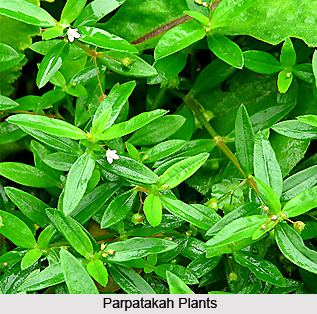
 Parpatakah is a medicinal plant found throughout the plains and lower parts of hills in India. They usually grow as a weed in moist habitats such as riverbanks, ditches, channels and bunds of paddy fields. It is a herb that spreads with angular, zig-zag stems, often rooting at lower stem nodes. The scientific name for this plant is Rungia repens Nees.
The leaves of Parpatakah plants are subsessile, 1.3 to 2 cms wide. These herbs are found in lanceolate to oblong-elliptic in shape. These are usually tapering to their bases and resemble thyme in both smell and taste. Flowers of Parpatakah or Rungia repens Nees are of different shades such as blue, pink, ivory-white and yellow and are pubescent to its outside. Flowers possess 2.5 to 6.3 cms long spikes with broadly elliptic bracts. Fruits or capsules are ovoid-oblong shaped with pale brown seeds.
The botanical name of this plant is `Justicia repens` and it is also popularly known as Parpata, or Parpatakah or Parpatha in Sanskrit, Khatsalio or Khatselio or Khatshedio in Gujarati, Kodagasale Gida in Kannada and Kharmar or Kharmor in Hindi.
Parpatakah plant plays a major role in medicinal properties and is used for various purposes. The dried, pulverized herb is used to treat cough and fever and is credited with ver-mifugal and diuretic properties. The fresh, bruised leaves are mixed with castor oil and applied to the scalp to cure tinea capi-tis, a scaly fungous infection that usually occurs in children. In Ayurveda, this herb is used as a substitute for Hedyolis corym-bosa (Rubiaceae), as a medicine for all types of fevers.
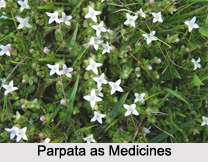 The Oldenlandia herbaeea or Parpata is a small, weak, straggling delicate plant, appearing in the rainy season in fields and low ground on the banks of water courses. The entire plant is used in medicine, and is regarded as a valuable bitter tonic and febrifuge. It enters into the composition of numerous prescriptions for