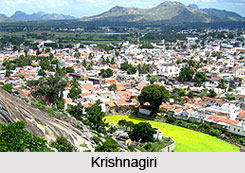
 This is the place, which was carved out of Dharmapuri district and regarded as the 30th district of Tamil Nadu. The name `krishnagiri` is derived from `Krishna` that means `black` and `giri` means `hill`. This district is gifted with black granite hillocks and thus named as `krishnagiri`.
There is another saying which gives the idea of naming the district and this can be mentioned as in earlier days the region came under the rule of Krishna Deva Raya and hence it might have been named after this king.
The four boundary of Krishnagiri district can be mentioned as it is bounded by Vellore and Thiruvannamalai districts in the East, Karnataka state in the west, Andhra Pradesh in the North and Dharmapuri District in the south.
The total geographical area of the district is 5143 Sq. Kms. This district is elevated from 300m to 1400m above the mean sea level. It is located between 11º 12`N to 12º 49`N Latitude, 77º 27`E to 78º 38`E Longitude. Eastern part of the district is hot while Western part has a contrasting cold climate.
The average rainfall is 830 mm per annum. The summer season can be experienced from March- June. July-November is Rainy Season and between December-February winter season is there. Three languages namely Tamil, Telugu and Kannada are spoken mainly here in this district. Major religions are Hindu, Islam and Christianity. All the people live with full integration and harmony. The people of different languages as well as cast and creed live here with full confidence.
The total population of the district is 15,46,700. Out of which 7,95,718 are males and 7,50,982 are females. Density of the population per sq. km is 301. Sex ratio of this district is 944/1000. The literacy rate is 58.11%.
The tribal folk named `Irular` live in the forest of Denkanikottai. These people are skilled in tree climbing, honey collection and protecting themselves from wild animals as well.
People of different casts and creed live in this Krishnagiri District. People from Kashmir, Maharashtra, Karnataka and Andhra have settled in this District as well. Hence this district can be truly called as a Cosmopolitan society. Ancient Art & Culture is preserved and maintained by inhabitants. The major entertainments for the people living here can be mentioned as `Street Play` or theru koothu and `Sevai Attam`.
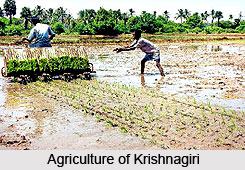 The land of Krishnagiri District is more suitable for cultivation of Horticulture crops. Other Plantation crops, medicinal plants, Fruits, Vegetables, Spices, and flowers are grown well by way of its moderate climate, high altitude and fertility of the soil. Horticultural crops are cultivated in the area of 38,248 Hec. Fruits are cultivated in the area of 32,162 Hec, vegetables are cultivated in the area of 9,773 Hec whereas spices and flowers are cultivated in the area of 4,398 Hec and 1,115 Hec respectively.
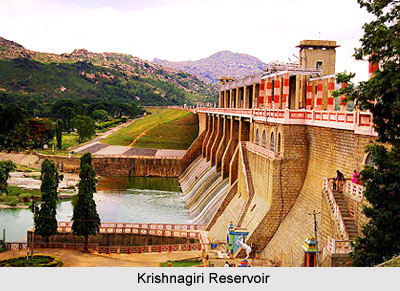 The Krishnagiri reservoir was build upstream of Sathanur Dam. Although the reservoir encompasses the same area as the dam, it is much shallower. The native species found in this reservoir were preserved but hardly used for commercial reasons. The species include P. sarana, Ompok bimaculatus, M. vittatus, Notopterus sp., murrels and others. A year after, species like catla, rohu, mrigal, C. cirrhosa, L. fimbriatus, C. carpio, C. reba, L. calbasu, Oreochromis mossambicus, L. kontius, P. dubius and Rhinomugil corsula are also stocked. The breeding rate was high initially, but now it has become moderate. This was a healthy drift, indicating the achievement of proper preservation. The present yield of the reservoir is only about 10.6 kg/ha/year with a range of 8.61 to 13.00 kg every hectare.
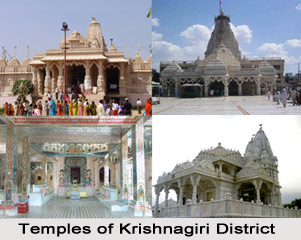 Temples of Krishnagiri district are mostly constructed on higher elevations and boasts unique sculptures, related to its past. Krishnagiri district is the holy land of wise scholars, men of valour and courage, blessed with the green valleys, hills and hillocks and inhabited by people known for pioneering in farming techniques. `Krishna` refers to `black` and `giri` refers to `hill`. This district is gifted with black granite hillocks and named as "krishnagiri". Most of the temples of Krishnagiri district are in close relation with the history of this land. The region came under the rule of Krishna Deva Raya and hence the district might have been named after this king.
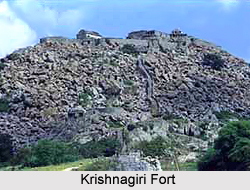 Krishnagiri Fort is an important fort located in Krishnagiri district in the
 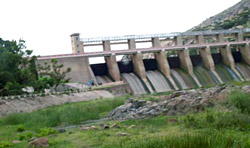 Krishnagiri dam is situated at the distance of 7 Kms from Krishnagiri. It is located between Dharmapuri and Krishnagiri. This dam helped in the irrigation of thousands of acres of land around Krishnagiri, which is in turn proved as very helpful for the district. This is a famous tourist spot too. This dam is flooded with tourists during the weekends.
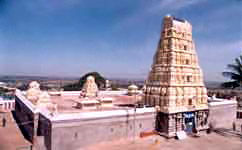 This temple is located in Hosur on NH-7. Most of the pilgrims that visit the place are mainly from Karnataka state. This temple stands on a hillock. Beside this temple there is a children`s park and an observatory is setup by the tourism department. A guesthouse is also functioning under the control of Tamil Nadu tourism. This is also placed nearby.