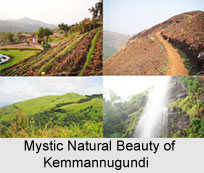
 Tourism in Kemmannugundi offers the scenic beauties of mountains, rivers and the beautiful streams. Kemmannugundi is a hill station and the hilly village in Tarikere taluk of Chikkamagaluru district of Karnataka. Also known as Krishnarajendra Hill Station, Kemmanagundi is a bounded by thick forests and has perfect climate throughout the year.
Kemmannugundi is about 1434m above sea level. The tourism of this place is famous for the summer retreat of Krishnaraja Wodeyar IV. This summer palace of Krishnaraja Wodeyar IV a mark of respect to the king, it is also known as Sri Krishnarajendra Hill Station. The station is ringed by the Baba Budan Giri Range, with cascade, mountain streams, and lush vegetation, Kemmangundi"s has ornamental gardens and mountains and valleys views. There is a spectacular sunset view from the Raj Bhavan or Government Palace.
Kemmannugundi is just 53 kilometres from Chikkamagaluru and 17 km from Lingadahalli by road. The nearest National Highways, NH-206 or NH-48, that connects to Bengaluru. There is another route via Mullayyanagiri, a scenic drive. If one is dependent only on public transport then one need to catch a private bus from Lingadahalli at 9.30am and the same bus (last bus) comes at Kemmanagundi at 4.30pm goes to Birur via Lingadahalli.
The hill station of Kemmannugundi was established as the summer retreat of Krishnaraja Wodeyar IV. He later donated this resort to the State Government of Karnataka. The Horticultural Department of Karnataka now develops and maintains the resort and its surroundings, which attracts large number of tourists.
Kemmanagundi has a Sub-Tropical Highland climate influenced by monsoon. It has three seasons the winter season is followed by summer and Monsoon. The cool climate throughout the year than most cities in the sub-continent is enjoyed by the December is the coldest month with mean temperature of 17 degree Celsius and April is the hottest with a mean of 22.2. The most precipitation falls in the month of July, with an average of 591 millimetres and February is the driest month of the year.
The Z Point in Kemmanagundi is a high point on a sheer hill, and it is a climb of about 30 minutes. The tourists can get a superb view of the surrounding region, including the gently trickling Shanthi Falls. The Hebbe Falls is a fascinating two stage waterfall. This waterfall is located near the place. Kalatti Falls, which is also known as Kalahasti Falls or Kalathagiri Falls, is located nearby and rushes down from a height of 120 meters. There is a temple in this place belonging to the Vijayanagara period. Mullayanagiri and the Bhadra Tiger Reserve are also a perfect spots to have a vacation near Kemmannugundi.