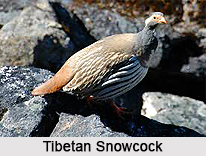
 Tibetan snowcock with a scientific name Tetraogallus tibetanus, is a bird in the pheasant family Phasianidae of the order Galliformes, gallinaceous birds. This species is found in high-altitude regions of the Western Himalayas and the Tibetan Plateau, where it overlaps in part with the larger Himalayan snowcock.
Structure of Tibetan snowcock
The head of Tibetan snowcock is greyish and there is a white crescent patch behind the eye and underside is white with black stripes. In flight the secondaries show a broad white trailing edge. Smaller than Himalayan snowcock, this species has a grey head and neck with a white patch behind the eye and above the dark cheek. Chin, throat and breast are white, with two grey bands on the breast. Grey wing coverts and tertials have a white trim. The secondaries have a broad white trailing edge that forms a wing band. Underparts are white with black streaks on flanks and belly. The tail is rufous brown and the undertail coverts are black. Legs and beaks are reddish.
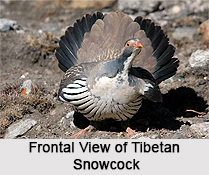 Concentration of Tibetan snowcock
Tibetan snowcock is described by John Gould in 1854. It is distributed across the Pamirs in Tadjikistan, southeast to Western Tibet and Ladakh. It is paler than the other races aquilonifer, described by Sushkin in 1926, is found in Central and East Himalayas (Nepal, Sikkim, western Bhutan), is darker and has darker brown tail centralis, described by Meinertzhagen in 1926, is sometimes lumped with przewalskii. This race is dark, and less fulvous than aquilonifer. This is found in central Tibet and extends to the Abor and the Mishmi Hills of India.
Races of Tibetan snowcock
The races of Tibetan snowcock such as tschimenensis and yunnanensis are not widely recognized, the former included in the nominate form. The genetic divergence of these populations has been attributed to glacial cycles associated with the uplift of the Tibetan plateau. Tibetan snowcock are found on alpine pastures stony ridges above the tree line in the Pamirs of Tajikistan, Himalayas (from Ladakh to Arunachal Pradesh), Tibet and China. They are found in lower altitudes during winter or when there is heavy snowfall. In parts of its range there appears to be a clear separation of the distribution of this and the Himalayan snowcock while in others they appear to overlap.