Third Chapter of Part Two
Third Chapter of Part Two of Brhadaranyaka Upanishad describes about the two forms of Brahman, gross and subtle, mortal and immortal, limited and unlimited, definite and indefinite.

Share this Article:

Third Chapter of Part Two, Brhadaranyaka Upanishad Brhadaranyaka Upanishad is the ancient and elementary part of Upanishad. It is related to the Shukla Yajur Veda. The Brhdaranyaka Upanishad is the secondary extraction of the Brahamana text. It is a commentary on Purush Sukta of the Vedas and contains symbolism, metaphors and imagery for relating the nature of reality. The third chapter of part two of Brhadaranyaka Upanishad states about the forms of Brahman which are mortal and immortal, gross and subtle, definite and indefinite and limited and unlimited. The gross form is different from akasa and air. The essence of that which is gross, mortal, limited and definite is the sun that shines for it is the essence of that exists.

Anything that does not have any form is the air and the ether. This is immortal, infinite, and indefinite. The essence of that has no form, that which is immortal, infinite and beyond is the spirit present in this universe. This refers to the divine relation. Here it states the relationship of soul with air and akasa. Whatever is immortal is unlimited and indefinite. That which is subtle, immortal, unlimited and which is indefinite is the person or Purusha in the solar orb. That person becomes the essence of the two elements that exists. This has been stated with reference to the gods. With reference to the subtle, it is the air and the akasa that is in the body. It is immortal, unlimited and is indefinite. The essence of that which is subtle, which is immortal, which is unlimited and which is indefinite is the Purusha that is in the right eye. The form of this spirit appears like a cloth dyed in turmeric, as the smoke colour of sheep wool, as the red colour of the Indragopa insect, as the bright colour of the fire flame, as the white colour of the lotus, as the lightning shines at one moment. He, who is aware of this, shines like a flash of lightning. Therefore the Brahman can be described as `the truth of truths.` The vital breath is truth and Brahman is the truth of that.
Share this Article:

Related Articles

More Articles in Indian Philosophy


Classical Indian Philosophy
Classical Indian Philosophy contains many analyses, rational principles and explanations. The Vedas have been considered as the first and the oldest scriptural texts of the Classical Indian Philosophy.
Ajivika Philosophy
Ajivika philosophy is different from the mainstream religion
Gunas - Hindu Philosophy
Guna in Hindu Philosophy in its philosophical sense refers to the constituent quality. The whole universe is guided by the three gunas, which are basically attitudes, qualities found in human being.
Bodhisattvas - Hindu Philosophy
Bodhisattva is a concept in Hindu philosophy and the Buddhist philosophy and refers to someone who is committed to attain Enlightenment.
Religion and Philosophy in Later Vedic Period
Religion and Philosophy in later Vedic period did see minute growth. However, rituals and traditions were religiously followed.
Theory of inference in Nyaya philosophy
Nyaya theory of inference is divided into five steps.
Theory for God in Nyaya philosophy
The Naiyayikas tried to establish the existence of God through logic.
Religious Influence on Indian Philosophy
Religious influence on Indian philosophy has been almost enigmatic, making it complimentary in perspective.
Morality and Ethics in Jain philosophy
Jains follow a fivefold path of morality and ethical purity, by which one can reach moksha.
Indian Philosophy In The Vedic Period
Indian Philosophy in the Vedic Period was primarily based on the concepts of nature worship.
Metaphysics in Jain philosophy
Metaphysics in Jain philosophy revolves heavily around the soul and its governing path and final emancipation.
Nether World in Jain Philosophy
Nether World according to Jain Cosmology consists of seven subterranean regions. Of the seven regions the above two regions serve as the abode of heavenly gods and in the rest torture of the souls is undertaken for any kind of misdeed.
Achintya Bheda Abheda Philosophy
Achintya-Bheda-Abheda is a School of Vedanta that represents the philosophy of unimaginable one-ness and difference in relation to the power creation and creator.
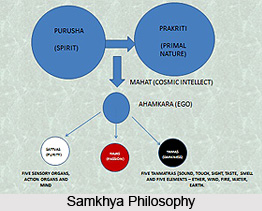
Samkhya Philosophy
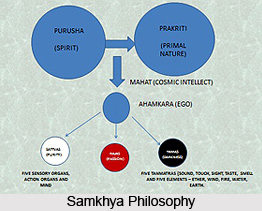
Samkhya philosophy is one of India’s oldest intellectual traditions, explaining reality through the interplay of Puruṣha (pure consciousness) and Prakrti (primordial nature). By enumerating twenty-five tattvas, it offers a rational path to liberation, emphasizing discernment, self-knowledge, and freedom from suffering through understanding the true nature of the Self.
Jain Cosmology
Jain Cosmolgy presents the universe in the form of a male figure. In the figure various body parts are dedicated to various lokas. For instance the region above the head is said to be the siddha lokas and so on.
Charvaka Philosophy
The Charvaka Philosophy believes that only those things that can be perceived is the ultimate reality.
Indian Philosophy
Indian Philosophy is intense spirituality that emphasises on the attainment of salvation and eternal bliss through a righteous path.
Jain Philosophy
Jain Philosophy is a religion and philosophy originating in ancient India that separates body from the soul completely. The concept of Jain philosophy has the non-violence among the people.
Twelve Nidanas
The twelve nidanas are aimed to understand the root cause of suffering in samsara, guided from ignorance and hankering.
Vedanta Philosophy
Vedanta Philosophy is one of the six orthodox systems. It consists of 555 Sutras and its observation and explanations are based on Samkhya system.