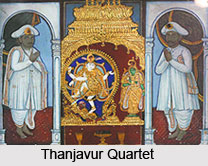
 Thanjavur Quartet or Tanjore Quartet is actually the four brothers who lived during the 18th century and contributed, in a major way, to the enhancement and development of the Indian classical dance of Bharatanatyam and Carnatic Music.
While they have made the art of Bharatanatyam dance popular to people through their training, they have also written a number of Tana varnams and Kritis. The brothers Chinnayya Pillai, Ponnayya Pillai, Sivanandam Pillai and Vadivelu Pillai were employed in the courts of the Maratha King Serfoji II at Thanjavur.
Musical Training of Thanjavur Quartet
With the patronage and encourage of the King, they became aware of the nuances of Carnatic music from a number of exponents of their time including Muthuswami Dikshitar. Dikshitar also appreciated the Vadivelu Pillai as an Ekasandhagrahi - one who had the capability to repeat a song heard only once. The quartet wrote a set of nine songs called Navaratna Mala in tribute of their teacher.
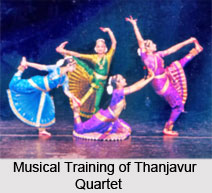 After a stint at the courts of Serfoji I, the brothers moved to Travancore and were patronized by Swati Tirunal. The king appointed Vadivelu Pillai as the court musician. Vadivelu Pillai also learnt to play the violin from a European missionary and introduced it in Carnatic music. Vadivelu also introduced the concept of Mohiniaattam. Until then Kathakali was the prevalent dance form in Kerala and was confined to male dancers. Vadivelu elaborated and refined Mohiniattam along with Maharaja Swathi Tirunal, and this paved the way for women dancers in Kerala.
Compositions of Thanjavur Quartet
There are many compositions by four brothers like Varnams and Kritis. Some of these, apart from the Navaratna Mala, are Amba Souramba and Amba Neelamba, Ambaneelambari (Neelambari), Satileni (Poorvikalyani).