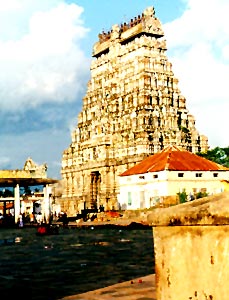
About Temples in Chidambaram
Chidambaram is hallowed by the aura of the famous shrine dedicated to Lord Shiva as Nataraja, the Cosmic Dancer. Here the Lord danced while blessing saints Patanjali and Vyagrapada, who were doing penance in the
This Cosmic Dance is a symbolic representation of the five fold activities of the God-- Creation, Preservation, Destruction, Veiling (Maya) and Blessing. Sri Nataraja`s Tandavs include Ananda Thandavam, Urdhwa Thandavam, Bhujangatrasa Thandavam and Ajabha Thandavam.
The sanctum is adorned by a gold-plated roof. This is also known as Ponnambalam or Kanaga Sabha. Devi Sivakama Sundari is consecrated by the side of the sanctum.
To the left is the Chidambara Rahasyam or the abode of Akasha Lingam. Only a Prabha or circular arch and a Vel (spear) with a golden Bilva mala are worshipped. This is one of the Pancha Bhutha Lingams representing Akasha or Ether. This shrine remains curtained. The five silver-plated steps leading to the shrine represent the mystic five letters of `Nama Shivaya.`
The shrine of Govindaraja Perumal is close to the Chit Sabha. Lord Subramanya is in another temple.
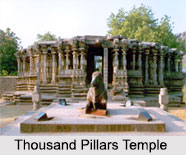
The temple has all the five Sabhas of Lord Shiva - Chit Sabha, Kanaga Sabha, Nritta Sabha, Deva Sabha and Raja Sabha. The famous Raja Sabha is in the Thousand-pillared Hall. Shaivite poet Sekkizhar first recited his Periya Puranam in this hall. The Nritta Sabha shows the Urdhwa Thandavam of the Lord. It is a porch of 56 pillars that have been delicately carved with dancing figures. This court represents a heavenly chariot carved out of stone. The Deva Sabha was used by the then administrators to hold meetings and festivals. The Raja Sabha was used by Chola and Pandya kings to hold victory celebrations.
Two of the temple`s 4 gopurams are covered with sculptures illustrating the 108 postures of Natya Shastra. Shivaganga is the sacred tank. The holy water, believed to have healing powers, had cured a king`s major disease.
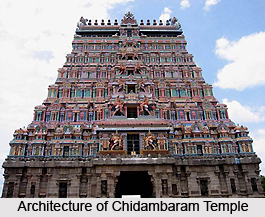
Architecture Of Chidambaram Temple
The architecture of Chidmbaram Temple is of special worth. It represents the assimilation of several styles of architecture. Chit Sabha is the innermost portion of the temple, the sanctum sanctorum. This is the place where Lord Shiva performed his cosmic dance. The Lord is represented here with his left leg raised up in a dance pose. The Chit Sabha is the holiest shrine of the temple. It is a wooden structure which has been supported with wooden pillars. It has a hut shaped roof and houses the images of Nataraja and Sivakami.
By the side of the Lord at Chidambaram, to the left, is the sanctum of Goddess Sivakama Sundari. To the right is the Chidambara Rahasyam wherein there is no image or Lingam. A Tiruvasi, the circular arch or Prabha with a Vel, is in front. The Prabha is marked by a string of golden Vilva leaves hung over it. Here Lord Siva is worshipped as Akasa which pervades the whole world. The stone steps leading to the Chit Sabha at Chidambaram are five in number and are plated with silver. They are said to represent the five mystic letters of the Panchakshara Mantra, NA, MA, SI, VA, YA. The door-posts are all silver-plated and bear an embossed representation of Vyaghrapada and Patanjali figuring as Dwarapalakas.
The roof of the temple is gold-plated. Hence it is called Ponnambalam. The conception of the idol of Nataraja, which has been claimed in the civilised world as the greatest work of Oriental art, is not merely a stroke of the imagination of an artist, but is a monument of the inner vision of the artist devotee, who could conceive the image of Lord Shiva as He revealed Himself to him. Modern scientists accept that each atom is nothing but a microscopic indivisible particle of God in perpetual motion in a circle. If there is such a motion there must be a Mover. If the Mover is immanent He must be in motion too. With this conception in mind the artist must have prayed for ages for getting the Divine revelation to put it into a concrete shape. In the figure of Nataraja both Mover and the moved are depicted in lifelike shape. This is the climax of revelation and that is Nataraja at Chidambaram. Science is personified in Act in the form of Nataraja.
In the second prakaram of the Chidambaram Temple is the Nritt Sabha or the hall of dance. The hall houses the image of Lord Shiva in the Urdhatandava pose winning over Kali in a dance duel. The Nritt Sabha is in the form of a chariot drawn by horses. The house of Gods known as the Dev Sabha is also in the second prakaram. It houses festival images of the Pancha Murtis (Somaskandar, Parvati, Vinayaka, Subramanya and Chandikeswara) and other deities. Mulanathar or the representation of Shiva as a Lingam is also placed in the second prakaram.
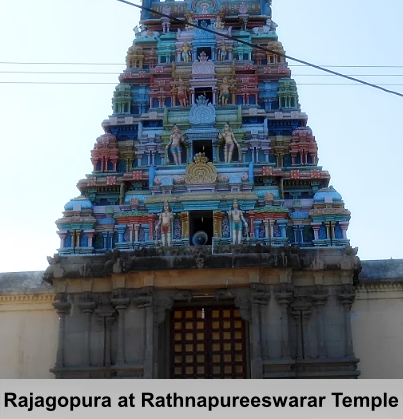
The most magnificent structures in the temple are the four lofty gopurams or towers in the four cardinal directions, piercing the walls of the outermost prakaram. Each of the gopuram is a massive structure. They are 250 feet in height and have seven tiers. The Western tower is the oldest one. The towers, on either side of the gateways represent 108 postures of the classical Bharatnatyam tradition. The towers are filled with images from Hindu mythology. From the second tier onward, on each of the gopuram, are found images of various representations of Shiva such as Bhikshatana, Kankala Kalyanasundarar, Somaskandar etc.
The temple architecture of Chidambaram Temple has a lot of philosophical meanings associated with it. Therefore it can be said that the temple was constructed not just for the sake of artistry but if properly understood it gives important lessons of life.
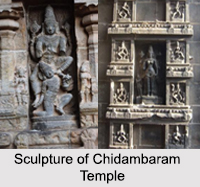
Sculpture of Chidambaram Temple
Sculpture of Chidambaram Temple gave birth to the sculpture and bronze image representation of Lord Shiva as the celestial dancer. It was commissioned by the Pallava king Swetavarman. One of the key features of this temple is that both "Shaivite" and "Vaishnavite" deities have been enshrined here. The presiding deities here are Lord Shiva Nataraja and Lord Govindaraja Perumal.
Chidambaram is a beautiful town in the Cuddalore district ruled from the beginning by Cholas, Vijayanagara`s, Maratha`s and the British rulers. It is believed that it was in Chidambaram that, Lord Shiva performed "Anandha Tandava" on the back of a demon and hence the name Nataraja.
Features of Sculpture of Chidambaram Temple : One of the major features of the sculpture of Chidambaram Temple is the bejewelled Nataraja idol. Chidambaram Temple in Tamil Nadu is one of the rare temples where Lord Shiva has been represented by an idol instead of a lingam. The well sculpted figure of the lord depicts him in a dancing pose, known as the cosmic dance. The oldest one amongst these is the Western "gopuram". Either side of the gateway towers has been adorned with sculpted figures.
One will come across the carved images of 108 Bharatnatyam dance poses and characters from Hindu mythology. It also shows goddess fighting the buffalo-demon and warlike "Skanda" astride his peacock. These figures have been used to embellish the first tiers. On the second tier of the "gopurams" Lord Shiva has been sculpted in several forms: "Bhikshatana", "Kankala", "Kalyanasundarar", "Somaskandar" and others. An interesting feature of the sculpture of Chidambaram temple "gopurams" is that the main figure of Lord Nataraja is missing. Usually a representation of the main deity is found on the towers of the South Indian temples.
There are nine well carved gateways in the Chidambaram temple. Four of these gateways have the "gopurams". One of the architectural features of the halls in Chidambaram temple is the well carved pillars. The finest examples of such pillars are found in the "Nritya Sabha". The "Nritya Sabha" or "Natya Sabha" is in the form of a chariot drawn by horses. According to legends this is the place where Lord Shiva and Goddess Kali have danced with each other. Raja Sabha is the thousand pillared hall that stands for the "Sahasraram" (a yogic chakra at the top of the head and a seta where the soul unites with God). This particular chakra is represented with the help of thousand petalled lotuses. The last one is the "Deva Sabha" where the "Pancha murtis" (five sculpted deities) are found. The five images are that of Lord Ganesha, Lord Somaskanda, His consort Sivananda Nayaki, Lord Muruga and Chandikeswarar, principle devotee of the lord. There are several sub shrines within the temple complex dedicated to several Hindu deities. These shrines have been adorned with sculptures around them.
Its bronze statues and stone sculptures depicts various deities and the famous "Thillai" trees of the surrounding forest. The sculptures of Chidambaram inspired the postures of classical dance of Bharatha Natyam. Two fishes facing each other were sculpted by the Pandyas. The East Gopuram has the idols of Pachaiappa Mudaliar and his wife Iyalammal. All "gopurams" have around fifty stone sculptures, each repeating some portions from the other.
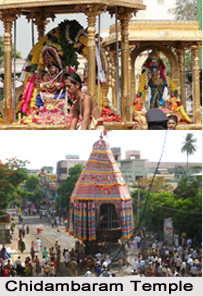
Festivals of Chidambaram temple
The temples of Chidambaram keep celebrating various festivals all around the year.
Some of them are discussed here:
• Arudhra Darshan in the month of December to January.
• Aani Thirumanjanam in June.
• 10-day Panguni Uthiram festival in March to April.
Natyanjali Festival : The Department of Tourism, Govt. of Tamil Nadu, the Ministry of Tourism, Government of India and Natyanjali Trust in Chidambaram jointly organise this festival of temples in Chidambaram. It is generally celebrated in February and opens on the Maha Sivarathri Day.
During the festival, prominent dancers of India perform their dance and offer it to the cosmic dancer Nataraja in the vicinity of his sanctum sanctorum. The festival is a unique tourist attraction. All the dances of India, both classical and modern are performed at that time.