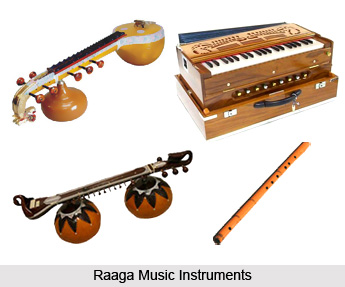
 Techniques in Indian Classical Music consist of the manner and matter of classical music. Raaga is the most important concept in Indian classical music. Raaga has been derived from the Sanskrit Language word `Ranja`, standing for an element that delights and enthrals the mind. Raaga is a combination of notes illustrated by melodic movements. There are numerous types of Raagas, like - Multani, Jaunpuri, Gaud, Sorath, Maand and Pahadi, Ahiri, Gurjari, Asavari, including several others. Raaga utilizes the entire range of the octave, starting with Aroha and ending in Avaroha, where the singer culminates the recital.
Rasa is pre-existent and gradually arises with musical clues. It is savoured and not dispersed. The word `Rasa` has three main aspects to it: physical, psychological and metaphysical. The first aspect is directly related to the actual meaning of the word i.e. juice or essence. With the second aspect, the psyche participates in the experience i.e. the sweetness of the Rasa of any fruit like mango or orange is tasted by the tongue to be felt by the mind. The experience is psychological based directly on the physical object. The third and the important aspect is the metaphysical aspect. Here the word Rasa is used to connote an experience which is neither merely physical nor psychological but outside the sphere of all such mundane activities. Some call it spiritual. This experience is attained only through the pursuit of artistic excellence and at the same time also has subconsciously a separate identity as a listener. When such a state is achieved only then the true Rasa can be experienced.
Rasa experience is one`s response to good music. It is direct intuition of a felt quality. When a singer presents raga with its Bandish is a specific Tala and if the listeners only feel the Swar Tala matrix, no Rasa can be said to be felt but the moment the next character of the entire Raga is evident and the listeners actually see the Raga as an embodiment of some feelings or emotions, Rasa seems to be flowing from such musical performance.
Scale of Indian Classical Music is based on the basic seven note system. The scale current today throughout India contains seven notes or "svars", and in order of ascent these are- Shadja, Rishabha, Ghandhara, Madhyama, Panchama, Dhaivata and Nishad, known however more popularly by their initials Sa, Re, Ga, Ma, Pa, Dha, Ni. These seven notes form a cluster known as the "Saptak", and there are three such possible combinations or "Saptaks". Of these seven notes, with the exception of the Sa and Pa which are always constant and fixed and cannot be either flattened or sharpened, all the other five notes, besides having a fundamental variety in relation to each other, also have shades of delicate variations in themselves.
Laya in Indian Music is the tempo of a musical piece. Laya is a simple concept though it is a complicated application. There have been some practical limits to usable tempo. Say for instance one beat every ten minutes would be slow that would make it musically useless. On the other end 100 beats per second would be so fast that it would be considered as a tone and not a rhythm.