
Classification of Raagas
Classification of Raagas can be done in a number of ways depending on the basis for classification. The most basic divide between Raagas is of two types- primary Raagas which include all the notes of the scale and secondary Raagas which are derived from primary Raagas.
Introduction
Classification of Raagas can be done based on a number of different criteria, and thus there are a number of different classifications of Raaga types. Different schools have different systems of classification. The northern and southern schools even today have different ideas on this subject. Sometimes even every individual musician has a system of his own. The fact is that there is no real written record of Indian music as such. These Raagas have really been handed down from tradition. The guru transmitted his knowledge to his disciple, and through a succession of such oral transmissions, the best that was in Indian music has actually come down.
Origin of Classification of Raagas
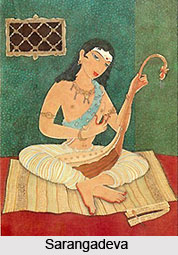
The classification of Raagas has been in existence since ancient times. In ancient India, music was classified in terms of Raagas (masculine), and their wives, called Ragini, which was sometimes expanded to include Putras (their sons) and Bharyas (wives of sons). With time, the Raagas were classified further. In the thirteenth-century, the total number of Raagas had increased to 264 and modern scholars have not yet been able to reconstruct these Raagas satisfactorily, in spite of the fact that a rudimentary form of notation, based on the Indian equivalent of the Western tonic sol-fa, was given by both Jsarngadeva and Matanga.
In the beginning of about the sixteenth century, a new system of classifying Raagas in terms of scales was introduced. These scales are called Mela in south India and That in north India. Mela and That are considered as the theoretical devices for the classification of Raagas in Indian music. Raagas may be heptatonic (sampurna), hexatonic (shadava), or pentatonic (audava). They have certain scalar elements; for example all Raagas have specified movements which enable the melody line of the Raaga to be carried from one octave to another, the ascending movement being called `droha` (drohana) and the descending movement, `avaroha` (avarohana).
Basically, all Raagas are divided into two important divisions:
(1) The primary Raagas which must include all the notes of the scale and in which the variations are in regular order, they number in all according to the southern system 72.
(2) The secondary or derivative Raagas formed from the primary Raaga numbering in all not more than 800.
In the beginning of about the sixteenth century, a new system of classifying Raagas in terms of scales was introduced. These scales are called Mela in south India and That in north India. Mela and That are considered as the theoretical devices for the classification of Raagas in Indian music. Raagas may be heptatonic (sampurna), hexatonic (shadava), or pentatonic (audava). They have certain scalar elements; for example all Raagas have specified movements which enable the melody line of the Raaga to be carried from one octave to another, the ascending movement being called `droha` (drohana) and the descending movement, `avaroha` (avarohana).
Basically, all Raagas are divided into two important divisions:
(1) The primary Raagas which must include all the notes of the scale and in which the variations are in regular order, they number in all according to the southern system 72.
(2) The secondary or derivative Raagas formed from the primary Raaga numbering in all not more than 800.
Classification of Raagas according to time
One way of classifying Raagas is according to the time of their performance. A day of 24 hours is divided into two - the diurnal and nocturnal halves. Of these, the `Dinegeya` or `Suryamsa Raagas` (diurnal) are rendered during the day, and the `Ratrigeya` or the `Chandramsa Raagas` are rendered during the night. The time punctuating the finish of day and the commencement of night is `Sandhi`, and the Raagas of this hour are called the `Sandhiprakash Raagas` or the Raagas rendered during the twilight time; while those sung at the conclusion of night and the beginning of morning are called `Pratah-Sandhi Raagas`.
Both the morning and the early evening Raagas share a fairly identical combination of notes. The major difference is that the morning Raagas use Shuddh Madhyam, while the Sandhiprakash Raagas of the evening use Tivra Madhyam.
Both the morning and the early evening Raagas share a fairly identical combination of notes. The major difference is that the morning Raagas use Shuddh Madhyam, while the Sandhiprakash Raagas of the evening use Tivra Madhyam.
Classification of Raagas according to mood
Another way in which Raagas are classified is according to mood. Every Raaga is said to represent a particular mood or emotion. As a matter of fact, the word Raaga originally meant passion. Bhairvi, once again, is the Raaga of asceticism, Vasant is the Raaga of spring, full of joy and exuberance, Asavari, wrapped in melancholy notes, is like one pleading for justice. So great indeed is the power of a Raaga, that it is actually supposed to create the conditions and emotions which it represents. They may rouse one to deeds of heroism or lull him into idleness and sleep.
Classification of Raagas according to Seasons
Besides the time-bound Raagas, there are Raagas associated with seasons. But unlike the time-bound Raagas, the seasonal associations are not so rigidly adhered to. Basant and Bahar, the Raagas associated with spring, and the Malhar group associated with monsoon, can be sung during the second Prahara of the night. Raagas like Desh and Maand enjoy a flexible temporality. Though a morning Raaga, Bhairavi usually forms the concluding piece in a late evening concert. Here precedence wins over habit.
Recently updated articles in Music in India
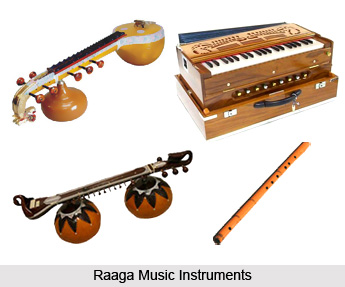
Classification of Raagas in Carnatic Music
Classification of Raagas in Carnatic music is based on scale type, devised as a system for raagas that existed as well as those that were in the proce...
Folk Music of Assam
Folk Music of Assam reflects the outdoor and indoor life of the folk people and it does not follow any strict rule of composition and performance. Fol...
Musical Instruments of Nagaland
Musical Instruments of Nagaland reflect its rich tribal heritage and deep cultural roots. Crafted from natural materials like bamboo, wood, and animal...

Rasa, Hindustani Music
Rasa is an important part of Hindustani Music. Here the creative experience of the artist i.e. musician and the aesthetic response of the connoisseurs...
Kshetrajna, Telugu Poet and Composer
Kshetrajna (1600 - 1680) was a creative Telugu poet and composer of Carnatic music. He composed several padams and keertanas.
Related articles in Music in India
Kriti Carnatic Music
Kriti refers to one of the most widely used genres of Carnatic music. It originated from the kirtanas of the bhaktas, i.e., musicians who expressed th...
Indian Folk Music
Indian Folk Music is full of rustic charm. The appeal of Indian folk music lies in the simplicity of its style and lyrics. Most of the folk songs are...
Haryanvi Music
Haryanvi music is the folk music of the state of Haryana and is sung in western Uttar Pradesh along with the neighbouring districts of Rajasthan and P...
Carnatic Music
Carnatic music, also known as `Karnataka Sangitam`, is one of the two styles of Indian classical music.