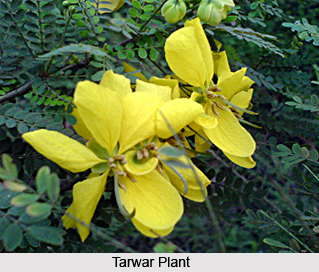
 Tarwar is abundantly branched, fast-growing, evergreen bushy plant having a height of about 7. It also possesses very smooth barks which are reddish-brown in colour. An Indo-Malaysian species which is native to India and Sri Lanka and introduced to various parts of Southeast Asia, it is found in the dry zones of peninsular India as far as the northern parts of Rajasthan. Typically found along roadsides and various other open degraded habitats and in scrub forests, usually on stony, dry or sandy soils. This plant is particularly common in Andhra Pradesh, Tamil Nadu and Karnataka. It is also grown in hedges and gardens in the northern parts of India from West Bengal to Haryana for decorative purpose.
The leaves of the plant Tarwar which is known as Aval in Gujarati are 7 to 12 centimeter in length. The stipules are large and persistent and they are 0.7 to 2.2 centimeter in width, reniform-rotund with a filiform point which is up to 0.7 centimeter in length, at the base of the petioles; leaflets are of 6 to 13 pairs, a little aromatic, oblong-obovate, emar-ginate or obtuse, from 1to 3.5 centimeter long and from 1 to 2 centimeter in width, having a vertical, orange gland in the middle of each pair of leaflets. The flowers of this plan which is known as Avaram in Tamil is yellow in colour and it is up to five centimeter across, in compound, terminal, corymbose racemes; pedicels are from 2 to 2.5 centimeter in length; bracts acuminate, ovate, caducous; calyx glabrous, concave, segments leathery, the outer two are smaller than the other three; petals having long claws, wrinkled at the margins and bright yellow patterned with orange. The fruit of Arsual, the name of this plant in Marathi is pale brown in colour. The fruit of Cassia auriculata, the botanical name of the plant Tarwar, is obtuse, oblong, mucronate, from five to 15 centimeter in length and from 1.2 to 1.8 centimeter in width, papery, flat, flexible, possessing 6 to 20 compressed seeds, narrowing towards the base. Tarwar, Indian medicinal plant gets its flower from the month of October till May and the fruits of this plant mature from the month of January till June and this depends on the local environment.
Awal, as this plant is known in Hindi, the bark of the plant is sour or bitter in taste and it is widely used for gargling in order to cure a sore throat, treatment of rheumatism and eye diseases and in enemas. This plant is used orally among the Kathodias of Rajasthan for the treatment of colds and coughs. This plant is also an element of a compound preparation which is used for the treatment of diabetes. Its extraction is used to give relief from stomachache and for the treatment of dysentery the juice of the fresh bark of this tree is used. The leaf of this plant is regarded as anthelmintic and the same is used for the treatment of ulcers, boils, swellings, skin diseases and leprosy. The infusion contains minor purgative properties. The powdered leaves of the Tarwar plant and Diospyros chloroxylon (Ebenaceae) are used externally along with coconut oil in order to give some relief from injury related pain. The pods of the plant are emetic and anthelmintic and used for the treatment of urinary discharges. The seeds of Tarwar are also considered vital and those are used in treating conjunctivitis and chronic purulent ophthalmia, gonorrhoea, gout and dysentery. In the state of Maharashtra, an extraction of the roots of Tarwar is mixed with Maytenus emarginatus (Celastraceae) is orally taken to get relief from rheumatic pains. Flowers of this plant are used to give relief from diabetes, throat trouble and urinary disorders. The aqueous extract of the leaves and flowers of this medicinal plant contains hypogly-caemic activity. The tannin-rich bark of this plant which is commercially called tangeedu bark or avaram bark is greatly valued for the purpose of tanning in South India.