
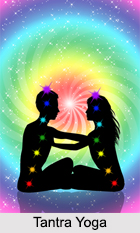
 Tantra Yoga holds a special place for the Hindus as it is a potent power for spiritual regeneration. It enlightens the one who is in darkness. It is a unique approach which studies the phenomenon of the entire universe from the perspective of the individual. A lot of sciences including astronomy, astrology, numerology, physiognomy, physics, chemistry, Ayurveda, psychology, mathematics and geometry are included within the realm of Tantra Yoga. Tantra Yoga does not limit itself to a particular branch of study rather it incorporates in it diverse elements which are linked together with a unifying rule of the Dharma. Rather the essence of Tantra Yoga is to understand the Dharma in the absolute sense.
Tantra Yoga
Tantra Yoga is the process to unfold spiritual nature through constant worshipping of Shakti as the deity. Tantra Yoga is the process which brings about awakening of the self.
Introduction
Tantra Yoga holds a special place for the Hindus as it is a potent power for spiritual regeneration. It enlightens the one who is in darkness. It is a unique approach which studies the phenomenon of the entire universe from the perspective of the individual. A lot of sciences including astronomy, astrology, numerology, physiognomy, physics, chemistry, Ayurveda, psychology, mathematics and geometry are included within the realm of Tantra Yoga. Tantra Yoga does not limit itself to a particular branch of study rather it incorporates in it diverse elements which are linked together with a unifying rule of the Dharma. Rather the essence of Tantra Yoga is to understand the Dharma in the absolute sense.Aims of Tantra Yoga
Tantra Yoga aims to bring in consciousness in all the three states of human life; that is, in the conscious state, the waking state and in the dream state. In order to attain this consciousness, the human mind needs to seek immense spiritualism and deep knowledge. Tantra Yoga teaches the methodology and the ways which discards intolerance, ignorance, selfishness and the animal instinct that is present in human beings. Tantra Yoga thus concentrates on a single point that helps individuals to emancipate the consciousness from limitation.
Role of Shakti in Tantra Yoga
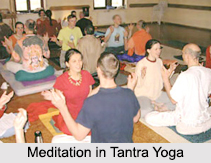 Universe is made of two opposing forces, while Lord Shiva being the static principal, Shakti is the dynamic force. Shakti stands for creativity, energy and power. The external part of everything is the creative aspect and inside every dynamic aspect lies the static part. The role of Shakti has neither any beginning nor any end. Although energy is restless yet it moves in an orderly cycle following alternate periods of rest and motion. The phenomenon of energy undergoes a lot of changes. It gets distorted and gets reorganized during its period of rest. Thus it can be said that there is a constant process of creation, preservation, destruction, reorganization and recreation in this world. According to the Tantra Yoga, Shakti is the Universal Mother who has the power to create, destroy and sustain. As a result the essence of Tantra Yoga lies in worshipping Shakti as an aspect of the Divine.
The world is illusory where the driving force is the power of desire (Ichcha Shakti). The desire is present in one who is without attributes or in the Brahmana. Tantra Yoga believes the primary driving force behind the universe is nothing but desire. Without desire it is not possible to go on with the continuity of this world. As a result Tantra Yoga does not encourage human beings to renounce their desires. The state of desirelessness can only be achieved with the help of asceticism according to Tantra Yoga and the paradox of Tantra Yoga is that an individual should have a strong desire to culminate to a state of desirelessness.
Recently updated articles in Yoga
Khanda Manda Yoga
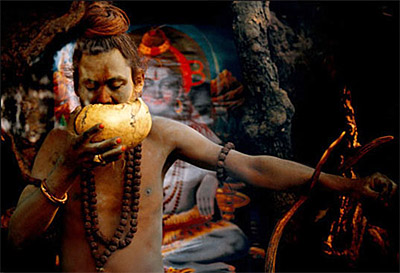
Khanda Manda Yoga is a difficult form of yoga where the Yogi cuts off his own arms and legs with a sharp cleaver, that is axe-like knife, and throws t...
Kaivalya Pada
Kaivalya Pada, the fourth chapter of Patanjali Yoga Sutra denotes an absolute, indivisible state of existence of the Yogi. The Kaivalya Pada is someti...
Vibhuti Pada
Vibhuti is the Sanskrit term for “power” or “manifestation.” In this third chapter, Patanjali introduces the final three limbs of Aṣṭanga Yoga, collec...
Sadhana Pada
Sadhana Pada in Patanjali Yoga Sutra denotes the idea of practicing yoga that leads to spiritual illumination. Sadhana, the Sanskrit term for “practic...
Samadhi Pada
Samadhi Pada is the first chapter of Patanjali Yoga Sutra. In this chapter, the author explains the essence of yoga, the nature of samadhi, and the me...
Related articles in Yoga
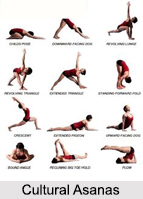
Cultural Asanas
Cultural Asanas refer to the daily physical exercise postures that train the body and mind in Yoga Practice.
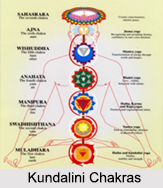
Kundalini Chakras
Kundalini Chakras are psychic energy centres or vortices, which connect between our psychic and physical energy systems.
Patanjali Yoga Sutras
Patanjali’s Yoga Sutras presents a foundational guide to the philosophy and practice of yoga. Through concise aphorisms, it outlines the nature of the...
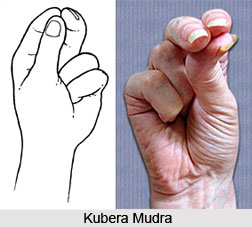
Kubera Mudra
Kubera Mudra, a form of Hatha Yoga, leads to the elevation of mental peace and physical relief by proper practice and cleanses frontal sinuses.