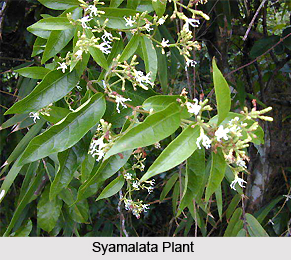
 Availability and cultivation of Syamalata
Syamalata is found almost throughout India to an altitude of 1200 metre from the western Himalayas southwards to Tamil Nadu and Kerala to Sri Lanka. In east the longitude spreads from Southeast Asia to northern Australia. It is typically a plant that grows in village surroundings and hedges.
Characteristic features of Syamalata
Syamalata is a large, evergreen, much-branched woody climber with rusty-tomentose branches. The leaves of the Syamalata plant are elliptic-oblong to broadly lanceolate, 2.5cm to 10cm long and 1.2 cm to 5 cm wide. The leaves have a pliable but tough surface and beneath lies soft woolly hair and the leaves are glabrous on the above surface. There is appearance of pubescent when the tree is young, the apex is acute, base is rounded or obtuse; petioles are 0.3 cm to 0.8 cm long. Flowers have good fragrance, and are greenish-white or purplish in colour. The corolla lobes are narrow, twisted and bearded, borne in axillary or terminal panicles of cymose clusters. The fruits (follicles) are cylindrical, slender and curved. They generally grow in pair and are 10cm to15 cm long and 4 cm wide. The seeds are slender, white with a coma, 1.2 cm to1.7 cm long. In central Indian deciduous forest areas, leaves turn reddish-brown before falling in February. The new leaves generally come out in March-April. In this region, the flowers basically blossom during October to December and fruits from February to April.
Medicinal properties of Syamalata
The roots of Syamalata are used in traditional medicine. It is also sometimes mixed with Indian sarsaparilla to prepare various medicines. They own a sweetish astringent taste but have the deficiency of the characteristic aroma of Indian sarsaparilla. They reportedly possess the properties of demulcent, alterative, tonic, diaphoretic and diuretic drug. They are often used as a curative medicine for fevers, dyspepsia and skin diseases, usually in combination with bitters and aromatics. The root powder is taken with milk for the treatment of diabetes, gall bladder stones, and as a blood-purifier. The tribal inhabitants of eastern Bihar consider it therapeutic for the treatment of filariasis. The entire part of the plant is used for treatment. A decoction of the leaves and stalks of Syamalata, or the decoction of the roots and leaves of Syamalata, is used to cure the patients suffering from fevers. The wounds between fingers are treated with the Syamalata plant by applying the leaves that are boiled in oil. This mixture is also used for getting relief from headaches and fevers.