
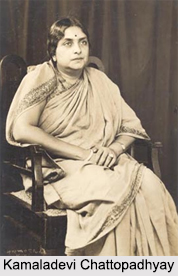
 Kamaladevi Chattopadhyay was the early founder of the All India Women"s Conference (AIWC). She was one of the greatest protagonists of Art in India. She was an eloquent speaker and an orator that could make audiences spell bound. She was very much interested in popularizing traditional Indian handicrafts and was popularly known as the "Hastkala Maa" meaning Mother of Handicrafts. A fearless fighter for social equality, she was the first Indian woman to stand for open political election in the mid-twenties. She was the" supreme romantic heroine" of Gandhiji`s salt Satyagraha movement, and was the first woman in Bombay Presidency to be arrested for breaking the salt laws.
Kamaladevi Chattopadhyay
Kamaladevi Chattopadhyay was the first woman in Bombay Presidency to be arrested for breaking the salt laws.
Introduction
Kamaladevi Chattopadhyay was the early founder of the All India Women"s Conference (AIWC). She was one of the greatest protagonists of Art in India. She was an eloquent speaker and an orator that could make audiences spell bound. She was very much interested in popularizing traditional Indian handicrafts and was popularly known as the "Hastkala Maa" meaning Mother of Handicrafts. A fearless fighter for social equality, she was the first Indian woman to stand for open political election in the mid-twenties. She was the" supreme romantic heroine" of Gandhiji`s salt Satyagraha movement, and was the first woman in Bombay Presidency to be arrested for breaking the salt laws.Early Life of Kamaladevi Chattopadhyay<
Early life of Kamaladevi Chattopadhay tells the tale of Indian freedom struggle. She was born on 3rd April in the year 1903, and was the fourth and youngest daughter of a Saraswat Brahmin couple in Mangalore. Ananthaya Dhareshwar, her father, was the District Collector of Mangalore, and her mother Girijabai, from whom she inherited an independent streak, belonged to an upper-class family from Indian state of Karnataka.
Kamaladevi`s grandmother was a writer and scholar herself. She wrote ancient Indian texts, and her mother was also pretty well educated which was mostly received from home. Jointly their presence in the house gave Kamaladevi a strong grounding and also provided yardstick to respect for her intellect as well as her voice, sometimes that she was came to be called for in the coming years, when she stood as voice of downtrodden s well as unheard.
As a student she was an exceptional talent and also showed qualities of courage and determination from a very early age. While she was growing up, her parents befriended many well-known freedom fighters and intellectual brains like that of Mahadev Govind Ranade, Gopal Krishna Gokhale, and women leaders like Ramabai Ranade, and Annie Besant, this made young Kamaladevi an early enthusiast of the swadeshi nationalist movement. She studied at great length about the ancient tradition of Sanskrit theatre in the Indian state of Kerala known as Kutiyattam, from its greatest Guru and authority of Abhinaya, Natyacharya Padma Shri Mani Madhava Chakyar by staying at Guru`s home at Killikkurussimangalam.
At a very early part of life tragedy struck her when Saguna, her elder sister, whom she considered as a role model died in her teens, soon after her early marriage and when she was just seven years old her father expired as well. To add to the trouble of her mother - Girijabai, he died without leaving a will for his vast property. Hence according to property laws of the times, the entire property went to her stepson, and they only got a monthly allowance. Her mother rather defiantly refused the allowance and decided to raise her daughter on her dowry property. Rebellious streak of her was visible even as a child, when young Kamaladevi questioned the patrician division of her mother`s household, and favoured to mix with her servants and their children wanting to understand their life as well.
Kamaladevi`s grandmother was a writer and scholar herself. She wrote ancient Indian texts, and her mother was also pretty well educated which was mostly received from home. Jointly their presence in the house gave Kamaladevi a strong grounding and also provided yardstick to respect for her intellect as well as her voice, sometimes that she was came to be called for in the coming years, when she stood as voice of downtrodden s well as unheard.
As a student she was an exceptional talent and also showed qualities of courage and determination from a very early age. While she was growing up, her parents befriended many well-known freedom fighters and intellectual brains like that of Mahadev Govind Ranade, Gopal Krishna Gokhale, and women leaders like Ramabai Ranade, and Annie Besant, this made young Kamaladevi an early enthusiast of the swadeshi nationalist movement. She studied at great length about the ancient tradition of Sanskrit theatre in the Indian state of Kerala known as Kutiyattam, from its greatest Guru and authority of Abhinaya, Natyacharya Padma Shri Mani Madhava Chakyar by staying at Guru`s home at Killikkurussimangalam.
At a very early part of life tragedy struck her when Saguna, her elder sister, whom she considered as a role model died in her teens, soon after her early marriage and when she was just seven years old her father expired as well. To add to the trouble of her mother - Girijabai, he died without leaving a will for his vast property. Hence according to property laws of the times, the entire property went to her stepson, and they only got a monthly allowance. Her mother rather defiantly refused the allowance and decided to raise her daughter on her dowry property. Rebellious streak of her was visible even as a child, when young Kamaladevi questioned the patrician division of her mother`s household, and favoured to mix with her servants and their children wanting to understand their life as well.
Political Life of Kamaladevi Chattopadhyay
Political life of Kamaladevi Chattopadhay started with the active participation in the Indian freedom struggle. While she was still in London pursuing her studies, Kamaladevi came to know the frenzy of Non-Cooperation Movement in 1923 that was led by Mahatma Gandhi. And she quickly made arrangements to return to India to join the Seva Dal - Gandhian organization established to encourage social upliftment. Very soon she was also placed in charge of the women`s section of the Dal where she got actively involved in training, recruiting and organizing girls and women of all ages from across India to become voluntary workers known as "Sevikas".
In the year 1926, she came across the person who was the founder of all India Women`s Conference (AIWC) and it also inspired her to run for the Madras Provincial Legislative Assembly. Thus she also became the first woman to also run for the Legislative seat in India. Inspite of the fact that she could campaign for only 2 days but the margin by which she lost was rather low - only a mere 200 votes.
The All-India Women`s Conference
The very next year she set up the All-India Women`s Conference (AIWC) and became its first Organizing Secretary, and AIWC grew up to become a national organization of repute, with branches and voluntary programs run throughout the nation, and work steadfastly for legislative reforms.
During her tenure she also travelled greatly to many European countries and also inspired to initiate several social reforms and community welfare program, and set up educational institutions, run for women, by women. Later during 1930s she was a part of Dandi March. On 26 January 1930 she captured the imagination of the entire nation when in a scuffle; she clung to the Indian tricolour to protect it. She was the first woman to be arrested during a freedom struggle. In the 1930 she was taken to prison by the British government for entering the Bombay Stock Exchange to sell packets of contraband salt, and spent almost a year in prison. In 1936, she became president of the Congress Socialist Party, working alongside Jayaprakash Narayan, Ram Manohar Lohia and Minocher Rustom Masani
For Kamaladevi Chattopadhay socialism was one of the main ideas and if needed she even opposed her own colleagues when they ignored or infringed women`s rights. For instance, when Mahatma Gandhi opposed the inclusion of women in the Dandi March (claiming that Englishmen would not hurt women, just as Hindus would not harm cows), Kamaladevi spoke out against this stand.
During the World War II she was in England and immediately began a world tour to explain the position of India to the world.
Post-Independence work by Kamaladevi Chattopadhay
With the independence of India came the issue of Partition and she immediately plunged into rehabilitation of the refugees, where she worked tirelessly to establish new homes, and new professions, for this they were trained in new skills, she also helped setting up health facilities in the new town.
In the year 1926, she came across the person who was the founder of all India Women`s Conference (AIWC) and it also inspired her to run for the Madras Provincial Legislative Assembly. Thus she also became the first woman to also run for the Legislative seat in India. Inspite of the fact that she could campaign for only 2 days but the margin by which she lost was rather low - only a mere 200 votes.
The All-India Women`s Conference
The very next year she set up the All-India Women`s Conference (AIWC) and became its first Organizing Secretary, and AIWC grew up to become a national organization of repute, with branches and voluntary programs run throughout the nation, and work steadfastly for legislative reforms.
During her tenure she also travelled greatly to many European countries and also inspired to initiate several social reforms and community welfare program, and set up educational institutions, run for women, by women. Later during 1930s she was a part of Dandi March. On 26 January 1930 she captured the imagination of the entire nation when in a scuffle; she clung to the Indian tricolour to protect it. She was the first woman to be arrested during a freedom struggle. In the 1930 she was taken to prison by the British government for entering the Bombay Stock Exchange to sell packets of contraband salt, and spent almost a year in prison. In 1936, she became president of the Congress Socialist Party, working alongside Jayaprakash Narayan, Ram Manohar Lohia and Minocher Rustom Masani
For Kamaladevi Chattopadhay socialism was one of the main ideas and if needed she even opposed her own colleagues when they ignored or infringed women`s rights. For instance, when Mahatma Gandhi opposed the inclusion of women in the Dandi March (claiming that Englishmen would not hurt women, just as Hindus would not harm cows), Kamaladevi spoke out against this stand.
During the World War II she was in England and immediately began a world tour to explain the position of India to the world.
Post-Independence work by Kamaladevi Chattopadhay
With the independence of India came the issue of Partition and she immediately plunged into rehabilitation of the refugees, where she worked tirelessly to establish new homes, and new professions, for this they were trained in new skills, she also helped setting up health facilities in the new town.
Bibliography of Kamaladevi Chattopadhyay
Kamaladevi Chattopadhyay was also a notable author. Some of the books written by her are as follows:
•The Awakening of Indian women, Everyman`s Press, 1939
•Japan-its weakness and strength, Padma Publications 1943
•Uncle Sam`s empire, Padma publications Ltd, 1944
•In war-torn China, Padma Publications, 1944
•Towards a National theatre, (All India Women`s Conference, Cultural Section), Aundh Pub. Trust, 1945
•America: The land of superlatives, Phoenix Publications, 1946
•At the Cross Roads, National Information and Publications, 1947
•Socialism and Society, Chetana, 1950
•Tribalism in India, Brill Academic Pub, 1978
•Handicrafts of India, Indian Council for Cultural Relations & New Age International Pub. Ltd., New Delhi, India, 1995
•Indian Women`s Battle for Freedom, South Asia Books, 1983
•Indian Carpets and Floor Coverings, All India Handicrafts Board, 1974.
•Indian embroidery, Wiley Eastern, 1977
•India`s Craft Tradition, Publications Division, Ministry of I & B, Govt. of India, 2000
•Indian Handicrafts Allied Publishers Pvt. Ltd, Bombay India, 1963.
•Traditions of Indian Folk Dance.
•The Glory of Indian Handicrafts, New Delhi, India: Clarion Books, 1985.
•Inner Recesses, Outer Spaces: Memoirs, 1986.
•The Awakening of Indian women, Everyman`s Press, 1939
•Japan-its weakness and strength, Padma Publications 1943
•Uncle Sam`s empire, Padma publications Ltd, 1944
•In war-torn China, Padma Publications, 1944
•Towards a National theatre, (All India Women`s Conference, Cultural Section), Aundh Pub. Trust, 1945
•America: The land of superlatives, Phoenix Publications, 1946
•At the Cross Roads, National Information and Publications, 1947
•Socialism and Society, Chetana, 1950
•Tribalism in India, Brill Academic Pub, 1978
•Handicrafts of India, Indian Council for Cultural Relations & New Age International Pub. Ltd., New Delhi, India, 1995
•Indian Women`s Battle for Freedom, South Asia Books, 1983
•Indian Carpets and Floor Coverings, All India Handicrafts Board, 1974.
•Indian embroidery, Wiley Eastern, 1977
•India`s Craft Tradition, Publications Division, Ministry of I & B, Govt. of India, 2000
•Indian Handicrafts Allied Publishers Pvt. Ltd, Bombay India, 1963.
•Traditions of Indian Folk Dance.
•The Glory of Indian Handicrafts, New Delhi, India: Clarion Books, 1985.
•Inner Recesses, Outer Spaces: Memoirs, 1986.
Achievements of Kamaladevi Chattopadhyay
Kamaladevi Chattopadhyay was the recipient of many national and international awards, including the prestigious Magsaysay Award, Vishwa Bharati"s Deshikotamma conferred on her by Indira Gandhi in 1970, and the Padma Vibhushan Award.
Kamaladevi Chattopadhyay alone had the insight and the will to champion a neglected cause. This great saga of patriotism and mother of handicrafts breathed her last in 1990.
Kamaladevi Chattopadhyay alone had the insight and the will to champion a neglected cause. This great saga of patriotism and mother of handicrafts breathed her last in 1990.
Recently updated articles in Personalities in India

Governors of Mizoram
The Governor of Mizoram is the constitutional head of the state and is appointed by the President of India. The Governor performs various constitution...
Governors of Jharkhand
Governors of Jharkhand have served as the constitutional heads of the state since its formation on 15 November 2000. Appointed by the President of Ind...
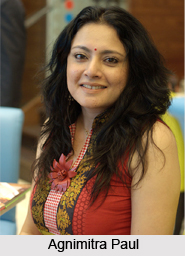
Agnimitra Paul
Agnimitra Paul is an Indian fashion designer and politician serving as a Member of the West Bengal Legislative Assembly from Asansol Dakshin. A senior...
Governors of Uttarakhand
Governor of Uttarakhand is the nominal head of the state. The Governor is also the representative of the President of India in the state of Uttarakhan...
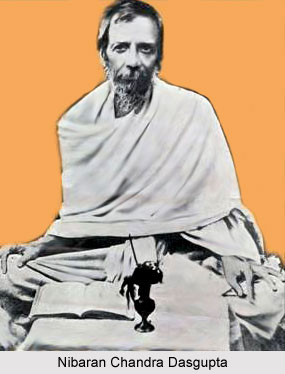
Nibaran Chandra Dasgupta
Nibaran Chandra Dasgupta was a distinct personality of Bengal who became famous for the establishment of ‘Shilpashram,’ a rural industry within the ma...
Related articles in Personalities in India

Sanskrit Theatre Personalities
Sanskrit Theatre Personalities was the main elements of Indian theatre with culture, customs and ethnicity.
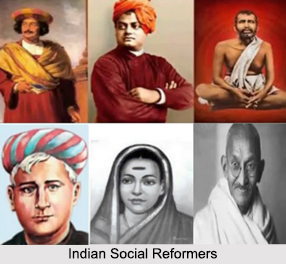
Indian Social Reformers
The Indian Social Reformers are responsible for liberating the nation of several social and religious evils.
Raja Ram Mohan Roy
Raja Ram Mohan Roy is a great Indian social reformer who is celebrated all over the country. He has done many operations for the liberation of women....