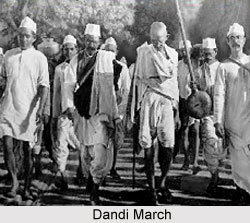
 Dandi March, popularly called The Salt March, also called the Salt Satyagraha started on 12th March in the year 1930, and formed a crucial part of the freedom movement. The march was organized to directly oppose against the action campaign of tax resistance and non-violent protest against the British monopoly of salt in colonial India, and also provoked the wider Civil Disobedience Movement. Ever since the Non-cooperation movement of 1920-22 this was the most organized movement against British authority and also directly followed the declaration of Purna Swaraj by Indian National Congress on 26th January 1930. Gandhi led the people in Dandi March from Sabarmati Ashram, his base near Ahmedabad to the sea coast near the village of Dandi in Gujarat.
During the course of the March, that continued for 23 days and 240 miles (390 Km) march to get salt without paying the tax, with growing numbers of Indians joined him along the way. On 6th April in the year 1930 when Gandhi broke the salt law it sparked large scale acts of Civil Disobedience by millions of Indian against the salt laws of British Raj. The campaign also had a crucial effect of changing the world and the attitudes of British towards the Independence of India. This campaign, however, had great effect among the people of India, as many of them joined hands to fight against the oppression.
Gandhi continued to meet people and addressing them on the way towards south. The group that Mahatma Gandhi led to Dandi staged Satyagraha at the Dharasana Salt Works, 25 miles south of Dandi, as per planned. In the process Gandhi was arrested on the midnight of 4rt May 1930 just few days before the planned action at Dharasana. The opposition through Dandi March gained worldwide popular in a very less time, and provided the required impetus for the Indian freedom movement.
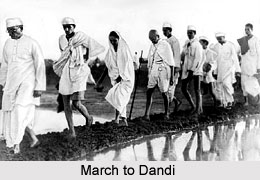 The Satyagraha against the salt tax continued for a very long time which of course ended with the release of Mahatma Gandhi from jail and negotiations with Viceroy Lord Irwin at the Second Table Conference. Over one lakh Indians were jailed as a result of Salt Satyagraha. But it did not result in major concession from British.
The campaign of Salt Satyagraha was based on the principles of Gandhi non violence known as Satyagraha, which is loosely translated as "Truth force". Literally it is also formed from the Sanskrit Language word called Satya - Truth and Agraha - Asking For. Indian National Congress, in the early 1930s chose the principle of Satyagraha as main ploy for attaining the Independence of India. As the first target to Satyagraha, Gandhi chose British Salt Act of 1882.
Dandi March caused a lot of furore among the people of India and among the people worldwide. Hundreds of protestors in Dharasana, and the worldwide coverage by the media also led to effective use of civil disobedience as a technique for fighting social and political injustice.
Dandi March created a major influence among the people of USA, especially American civil rights activist Martin Luther King, Jr., and his fight for civil rights for blacks and other minority groups in the 1960s