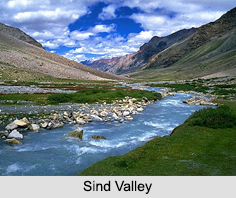
 Sind Valley is a Himalayan sub-valley of the Kashmir Valley in the State of Jammu and Kashmir of India. The entrance of the Sind Valley lies 33 kilometres (21 mi) northeast of Srinagar the capital of Jammu and Kashmir. The valley begins in Ganderbal and ends near Baltal and the start of the Zojila Pass. Sindh Valley is the main route between Kashmir and Central Asia.
History of Sind Valley
Sind Valley was the one of the major bridges in the past which connected India to China and other central parts of Asia. First Hinduism and Buddhism and then Islam spread in Kashmir through this route.
Location of Sind Valley
Sind Valley is situated in the Ganderbal district of Jammu and Kashmir. It is bordered by the Kashmir Valley in the west, Zojila Pass in the east, Kishanganga in the north and the Lidder Valley in the south. The Sind Valley connects Ladakh with the rest of India through a National Highway NH 1D, though it remains closed during winter due to heavy snowfall at Zojila.
Geography of Sind Valley
Sind Valley is formed by the flow of the Sind River; it extends up to 65 km in length and 1 km in width which flows down from east to west. The river originates from the inner Himalayas at Drass in Machoi Glacier and runs through green forests of pine and fir and alpine meadows of Sonmarg. The Sind Valley contributes heavily to the economy of the State, through generation of hydroelectricity, provides fresh water supply to other districts and irrigation for agriculture. The Sind River flows through the entire valley passing several natural landmarks. The main towns in the valley are Gund, Mammer, Kangan, Wangath, Preng, Wussan and Manigam.
Geology of Sind Valley
Sind Valley has formed over a period of several thousand years as the Sind River cuts into the Himalayan Mountains. The glaciers of the valley are shrinking. Today, the river continues to deposit the sheets of sand in the lower areas of Ganderbal. Gradual erosive processes have washed away side forests and created a deep gorge at many places.
Ecology of Sind Valley
Sind Valley has many glacier fed streams and is home to different types of trout. As the region is rich in dense vegetation, it is inhabited by several species of animals and plants. The valley is the natural habitat of Himalayan black bear, the Himalayan brown bear, musk deer, snow leopard and hangul. Markhor and ibex are also spotted in Sonmarg of the Sind Valley.
Visiting Information of Sind Valley
The nearest airport from Sind Valley is in Srinagar at a distance of around 35 km. Srinagar railway station is the nearest railhead. One can hire a cab to Sind Valley from both airport and railway station. During the summer season, Sind Valley can be easily accessed by road.