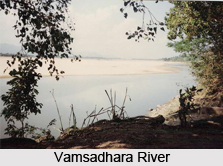
 Salihundam village and `Panchayat` is located in Gara Mandal, Srikakulam District in the southern Indian state of Andhra Pradesh, on the banks of Vamsadhara River. It is situated at a distance of nearly 18 km from the town of Srikakulam and 5 kms from the western portion of Kalingapatnam.
Previously, Salihundan was referred to as `Salivatika`, which implies `rice emporium`, though many others address the region as `Salyapetika` or box containing relics or bones. The village of Salihundam provides refuge to numerable Buddhist stupas and a gigantic monastic complex, amidst spectacular scenic beauty of Mother Nature. During the year 1919, this Buddhist archaeological site was discovered by Gidigu Venkata Ramana Moorthy while another person named Ponnana Simhachalam also unearthed the site in 2013.
A `Chaityagriha`, four Buddhist stupas, marvellous sculptures, structural temples and relic caskets are amongst the renowned archaeological marvels revealed from this site. The sculptures of Salihundam portray the three phases of the faith of Buddhism which includes `Vajrayana`, `Theravada` and `Mahayana`, which can be traced back to 2nd century BC till the 12th century AD. Other artefacts discovered are the idols of `Marichi` and `Tara`. A gateway is giving access to rubble paved ramp at the end of which is a spherical sanctuary right on the summit of hill. Numerous stones of this ramp are engraved with stone pilgrim`s records in ornamental shell characters. On both sides of the ramp, are cluster of structures - sanctuaries, apsidal, circular and oblong stupas, pillared mandapa etc. The most important edifice is the circular stupa sanctuary fronted by oblong porch built on the highest terrace.
It is believed that Buddhism had propagated to Sumatra and numerous other distant lands through Kalingapatnam Port and Vamsadhara River, from this very Indian village. One will notice a tiny gap in between the stones of the hill and it is believed that is somebody drops a coin in that gap; it would reach the `Garba Gudi` or the Srikakulam Temple. Local folklore states that this secret pathway was utilized as a source of communication in the olden days.
Travellers will also come across an ancient well at Salihunda village, in which exists a horizontal brick-wall. A rumour is associated to this well which asserts that a treasure is present deep inside the well. However, the truth lies enveloped in mystery till date. One will be able to reach Salihundam from Srikakulam District.