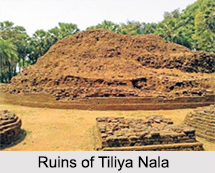
 Ruins of Tiliya Nala are located in Varanasi just above the nala or stream, on the high ground of its left bank. It is located close to the main street under which the stream flows. Ganga River is located in the vicinity of the stream. Judging from the present condition, Tiliya Nala must have been earlier extended across its present bed.
Structures in the Ruins of Tiliya Nala
The Tiliya Nala consists of 17 massive square columns, in three rows. These were four double columns in the front row, 4 single ones in the 2nd, and 5 in the 3rd or innermost row. The throne of Buddha has been placed between the 3rd and 4th pillars of the last row. It is a huge slab of stone that is 9 feet 3 inches in length, and 5 feet and a half in breadth. The slab retreats beyond the boundary wall into which all the pillars of this row are inserted. Earlier the throne of Gautama Buddha was placed in the centre of the building. There are presently 3 pillars situated in the right hand side. Similarly in the past there were pillars in each of the 3 rows to the left. The front row however, had double pillars throughout. There were therefore, one row of 6 double pillars, and two rows of 6 single pillars, or 24 pillars in all.
Each capital of the building is ornamented with the bell pendant. After the Buddhists, it was much used by the Brahmins. The double columns have been surmounted by one huge capital. They are almost 5 feet and a half in breadth. Along with this, each capital possesses a long arm for the eaves stone. 2 domes can be seen over the 2 inner rows. One of the dome which is above the "Simhasan" or throne is much more ornamented and looks attractive than the other. According to the research work done here, it is thought that there must have been a third dome here to the left of the central dome, corresponding to that on the right.
Outside the building, a fine basement moulding can be seen. It is believed that later it was seized and reconstructed by the Mohammedans. It is estimated that the building was earlier 54 feet in length, and about 24 feet in breadth. It is thought that the Muslims may have completely altered the ancient structure very minutely while transforming it into a mosque. Some of the large stones, which were used during the building of the mosque, have fallen into the nala or stream and upon its banks. The others have, perhaps, been used in the repairs of the bridge and of its adjoining stone wall. Though the mosque is now in dilapidated state yet it is still worth visiting and is visited by many tourists from far off places.