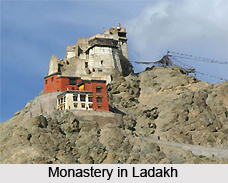
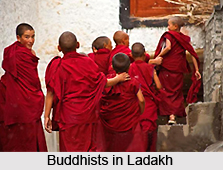
 Religion of Ladakh mainly lies in the practice of Buddhism. The non-Buddhist Communities includes Shia and Sunni Muslims as well as the practitioners of Christianity. Of the three major religions found in Ladakh, the Christians form a small part. The Buddhists and Muslims are found in more or less equal numbers, with predominance of Buddhists in the north and east, and of Muslims to the south and west. It is believed that the earliest practiced religion in Ladakh was some form of the Bon-Chos. This implied some kind of a collection of cults than a unified religion, pantheistic and shamanistic, and perhaps including a form of ancestor worship.
Buddhism in Ladakh
Buddhism is of critical importance for about half the Ladakhis. It is certain that Buddhism first entered the western parts of the contemporary Ladakh from Kashmir, perhaps as early as the first or second century AD, when there are indications that parts of the country may have been incorporated in the Kushana Empire. The Buddhist influence continued to filter in from Kashmir, which was one of its important centres. In its first and Second Spreadings, Buddhism reached Tibet from India and in the case of the latter Ladakh played a major role. In fact, Central Ladakh was the stronghold of Buddhism.
The influence of Buddhism on Ladakh has been quite immense, and for a long time the Ladakhi life and ways of thought have been shaped by Buddhism. Infact, at the approach to every village, there can be seen a number of Chorten, the Stupas of ancient Indian Buddhism, referring in their origin to the grave-mounds erected over the divided ashes of Gautama Buddha. The popularly practiced form of Buddhism here is Vajrayana Buddhism which was prevalent in Tibet.
 Muslims in Ladakh
The majority of Muslims in Ladakh can be found in Kargil town, Drass, the Suru valley comprising Parkachik, Pashkyum and Shagkar-Chigtan. Mulbekh and Bodh Kharbu have mixed populations, with a distinct Buddhist majority. Zanskar, too, is basically a Buddhist area but there is a small Muslim community there. The Muslims here are the descendants of immigrants from the Jammu region who came in the wake of Zorawar Singh`s invasion.
The Muslim community is also found in Leh as well as a few of the surrounding villages. They are said to have descended either from immigrants, or from marriages contracted by local women with Muslim merchants from Kashmir and Yarkand settled in Leh. This mixed community, the Arghons, Sunnis by belief, have an influence in the town out of all proportion to their fairly small numbers.
Some members of the Muslim community are also present in the remote villages of Turtuk and Bogdang.
Christians in Ladakh
The Christian community can be seen centred in Leh and some of the surrounding villages. The Christians belong to the upper classes of society.