 Regency of Bharata starts after the exile of Rama along with Lakshmana and Sita to the jungle and the death of Dasaratha. As a result of the evil scheming of Kaikeyi inspired by the hump-backed maid-servant Manthara, Rama was banished to the jungle for fourteen years and preparation for the coronation of Bharata to the throne of Ayodhya was made. After the departure of Rama, Lakshmana and Sita to the jungle, Dasaratha was not able to bear the shock and died. Bharata was summoned from his uncle`s kingdom along with Shatrughna to perform the last funeral rites of his father Dasaratha and to adorn the throne of Ayodhya. Bharata performed all the funeral rites of his father but was reluctant to accept the throne of the kingdom and decided to bring back Rama, Lakshmana and Sita to Ayodhya.
On the fourteenth day from the date of Dasaratha`s death, the ministers requested Bharata to take his seat upon the throne; but he refused, and gave orders to prepare an expedition to go in search of Rama. When all was ready he mounted a car and set out on the way along with six thousand other cars, and a thousand elephants, and a hundred thousand cavalry, and men of rank, and citizens, as traders and merchants, weavers and potters and armourers, goldsmiths and washer men and actors, and beside these several learned men and well-respected Brahmins. Passing through the realm of Guha, the host was entertained by him, and again by Bharadwaja at Prayag. One word Bharadwaja spoke to Bharata that he should not blame Kaikeyi since the exile of the king was for the good of men and gods and asuras and hermits.
From Prayag the mighty host marched on to Chitrakuta, and came to Rama`s hermitage. Then Bharata advanced alone, and fell at his brother`s feet. Rama sat in the leaf-thatched house, crowned with matted locks and clad in a black deer`s skin; like a flame he was and lion-shouldered, mighty-armed and lotus-eyed, lord of this sea-girt world he seemed, like to the ever-living Brahma, and by his side were Lakshmana and Sita. Then Bharata wept to see his brother thus, who was used to royal state. But Rama raised him from the ground and kissed his head and asked him of Dasaratha and his own well-being. Then Bharata related all that had come to pass, and prayed Rama to return to Ayodhya and rule, but Rama would not.
Rama told Bharata that the words of his father and mother should be obeyed perfectly and requested Bharata to return Ayodhya and rule his kingdom. He also requested him not to blame Kaikeyi since what was destined to happen happened and told his brother that he had the sole right over Ayodhya and he was the heir to the throne. However, Bharata told Rama if Ayodhya belonged to him then he wants to give it to his elder brother and requested him to accept it. But Rama was unmoved by the arguments of Bharata or any of the host.
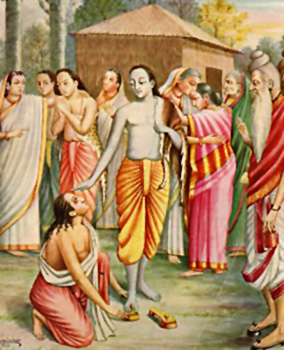
Lastly Bharata prayed before Rama for his golden sandals, and, bowing down to them, vowed that for the fourteen years he would dwell as a hermit without the walls of Ayodhya, and would keep his sandals over the throne and rule Ayodhya as his regent. To this proposal Rama consented and gave away his sandals to Bharata and embracing Bharata and Shatrughna told not to blame Kaikeyi further. Then Bharata walked sun-wise about Rama, and, placing the sandals on an elephant, took them back to Ayodhya, followed by all that host of men. There he installed the sandals on the throne, and, living in retirement, carried on the government as a representative of Rama.
Rama decided not to live any further in Chitrakuta since the rakshasas annoyed the hermits of that place because of their hatred towards him and also because the host of men from Ayodhya had trampled and defiled the place, and moreover, it reminded him too sharply of his brother`s grief and the citizen`s and queen mothers. He thus went, along with Lakshmana and Sita toward Dandaka, and entered that deep forest like the sun that is hidden by a mass of clouds.