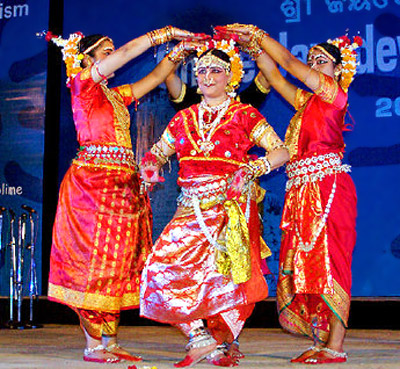
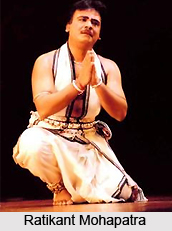
 A decade ago one of the leading newspaper Times of India complemented Ratikant Mohapatra as "The young Kelu Charan". Ratikant Mohapatra as a dancer, instrumentalist, teacher, choreographer and archivist of the traditional art form Odissi, has rose to the fame by securing a position in the arena. Ratikant Mohapatra was born to the family of legendary maestro of Odissi dance Padmabibushan Kelucharan Mohapatra and his wife Laxmipriya Mohapatra. For Ratikant Mohapatra having birth into such a family of rich heritage is undoubtedly an advantage. However it is obvious that Ratikant Mohapatra was guided by his father, who himself was the Maestro of the art of Odissi & mardala (Odissi Pakhawaj).
Being the son of such legendary person, Ratikant Mohapatra did not pay any special effort to emerge as a gemstone of a necklace of Odissi dance. He raised to the fame a prominent male Odissi dancer by the time of his early twenties. At his thirties he started performing on the global stage of Odissi. By that time he has established himself as one of the leading Odissi dance exponent by making his foot impression as an accomplished achiever. Ratikant Mohapatra`s performances at the world stage, at highly esteemed festivals boosted the thrust within him to live up to the perfect image of an original performer.
Ratikant Mohapatra has mastered in the mardala (Odissi Pakhawaj) and its nuances. His mastery over the mardala (Odissi Pakhawaj) helped him to step into the footprints that his father left for the perfect successor of this traditional heritage. Guru Kelucharan Mohapatra`s son successfully stepped into the shoes and exhibited his class as a percussionist and the singular brand of the Kelu Charan gharana. The hypnotic percussion skills of the Kelu Charan gharana have been reflected through his performances. Thus Ratikant Mohapatra has emerged as the second generation teacher who joined the association much ahead of his time.
After achieving such honor and esteem, Ratikant Mohapatra never stopped his pursuance for the advancement of the traditionally rich heritage art form, Odissi. He continuously tried to blend this art with advance technology and all he tried single-mindedly. For this purpose he started collecting the works done by his father and other advocators of Odissi dance. His main aim behind this purpose was to enhance the knowledge of scholars and researchers. Today his archive has already generated envy amongst the highly established institutions of the country and the world at large, as it possesses rare collections of articles, audio and video recordings of other Gurus and dancers of Odissi.
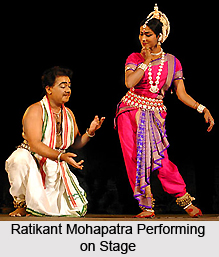 Some major performances staged by Ratikant Mohanty are: France- Festival of India and International Mime Festival; Germany- Festival of India and Autumn Festival; Japan - Festival of India; Russia- Festival of India; United Kingdom- Festival of India, Sanskritik Festival; Canada- Society of Fine Arts & Dance Academy of Ms Meneka Thakkar; Hong Kong- Vrundavan Dance & Music Academy of Pdt.Hari Prasad Chaurasia; Dubai- Sponsored Programmes; USA- 70th International Birth Anniversary Celebration of Guru Kelucharan Mohapatra in 1996, India Festival, Sponsored programs; Australia- ICCR Cultural Delegate & Sponsored programmes.
As recognition of his talent he has conferred many esteems. Ratikant Mohanty was invited by the ministry of Human Resource Development, Dept.of Culture, Govt.of India as an expert committee member to select the candidates under the scheme of Scholarship to young artists in different cultural forms; Received junior fellowship on Mardala from Ministry of Human Resource Development, Govt.of India; Received a state level "Nrutyasri Award" from Mohansunder Devgoswami Smruti Sansad, Puri; Invited by the national Song & Drama Division, Govt. of India as the Expert Member of the screening committee for selecting the artistes; Awarded for the best presentation of Odissi dance for Cultural & Philanthropic Society, Calcutta High Court; Barabati Nrutyotsav (national Festival of Dance & Music), Cuttack, awarded "Honour of Adore" for the best performance in Dashanana ballet in 2003; Honoured by Indian Performing Arts Promotion Inc., Washington Dc, USA for the valued contributuin in Odissi dance in 2003; Honoured with the National Award "Pride of India" by Chinta-O-Chetna, Bhubaneswar 2004; Honoured with "Sanjukta Panigrahi Samman" by Sanjukta Panigrahi Memorial Trust, Bhubaneswar, 2005; Honoured with "Nrutya Bhushan" by International Dance & Theatre Festival 2005 at Cuttack.
Ratikant Mohanty as the Director of Srjan (guru Kelucharan Mohapatra Odissi Nrityabasa) has established and raised the institution to the fame in its zenith. Today Srijan has established as one of the premium Odissi dance institute. As a teacher Ratikant Mohapatra on a regular basis conducted workshops and summer camps for senior students as well as beginners. He aims at continuing the age-old tradition that he has inherited from his father. The institute every year conferred an award, namely the Guru Kelu Charan Mohapatra Award at Bhubaneswar (Orissa). To ornament the function many far famed celebrities and performers of Indian classical music and dance gathered under one umbrella. Due to Ratikant`s dedication to grow the art and culture rapidly, this whole plan got its materialized shape.
This multifaceted personality has been gifted with the qualities of a true performer. The classical Odissi tradition comprised of the three aspects of a dancer, percussionist and choreographer. With the hands of this illustrious son of legendary Kelucharan Mohapatra, new avenues opened up, which eventually led to the new compositions based on the traditional classical framework of Odissi. Ratikant Mohapatra has presented this kind of new compositions recently. His works have received applauded reviews from the leading dance critics of the press columns.
In these times, Ratikant Mohapatra is endlessly working to carry forth the heritage of Kelu Charan Mohapatra. For that he is involved in incorporating many other aspects of Odissi in a very précised composed and structured way. The main aim is to spread the tradition throughout the world and to reach out the thousand aspirants of Odissi dance. For that purpose Ratikant Mohapatra has toured in an extensive manner. In this course he came to explore to multicultural forms of dance and he in a beautifying manner tried to bridge the gap that was prevalent between the traditional old Odissi and the rest of the world.