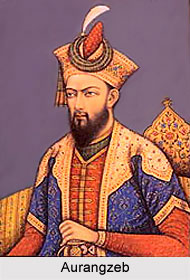
 Rajput policies adopted by Aurangzeb were strict and stern. Aurangzeb reversed the policy which was enunciated by Akbar and pursued by Jahangir and Shah Jahan. The Rajputs were the greatest obstacle in his pursuance of policy against the Hindus. Aurangzeb, therefore, attempted to destroy the power of the Rajputs and annex their kingdoms. There were three important Rajput rulers at that time, viz. Raja Jaswant Singh of Marwar, Rana Raj Singh of Mewar and Raja Jai Sing of Jaipur. All the three were at peace with the Mughals when Aurangzeb ascended the throne. But, Aurangzeb never kept faith in the loyalty of these Rajput rulers.
Aurangzeb deputed Raja Jai Singh in the Deccan where, ultimately he died in 1666 A.D. Raja Jaswant Singh was deputed to defend the north-western frontier of the empire. Two of his sons died fighting against the Afghan rebels and he himself died in Afghanistan in 1678 A.D. Aurangzeb was waiting for this opportunity. At that time, there was no successor to the throne of Marwar. He occupied Marwar immediately and, with a view to disgrace the ruling family, sold the throne of Jaswant Singh for rupees thirty-six lakhs. It seemed that the existence of Marwar was lost for ever. But, Marwar was saved. While returning from Afghanistan, the two wives of Rana Jaswant Singh gave birth to two sons at Lahore. One of them died but the other named Ajit Singh remained alive. Durga Das, the commander-in-chief of the Rathors came to Delhi with the prince and requested Aurangzeb to hand over Marwar to Maharaja Ajit Singh. Aurangzeb did not agree. Ajit Singh was declared the ruler of Marwar and the war of independence of Marwar began from that time.
Rana Raj Singh of Mewar, who realised that it was in the interest of Mewar to fight against the Mughals, gave support to Marwar. In 1681 A.D., Akbar, son of Aurangzeb revolted against his father with the support of the Rajputs. The revolt of Akbar failed and he fled to Maharashtra under the protection of Durga Das. Aurangzeb offered peace to Mewar and it was accepted. The Rathors of Marwar, however, continued their fight against the Mughals. Pursuing his son Akbar, Aurangzeb left for Deccan and could never come back from there. Marwar fought against the Mughals till the death of the emperor in 1707 A.D., of course, accepting peace in between twice, and finally succeeded in gaining its independence.
Thus, Aurangzeb failed to subdue either Mewar or Marwar. The only result of his policy against these states was that he lost the support of the Rajputs. The Rajputs, who were one of the best supporters of the Mughal Empire since the reign of Akbar, revolted against Aurangzeb. Their services could no more be utilised in strengthening the Mughal empire. On the contrary, it added to the troubles of the empire. It encouraged other revolts also. Thus, the Rajput policy of Aurangzeb failed and its failure contributed to the failure of Aurangzeb and resulted in the weakening of the Mughal Empire.