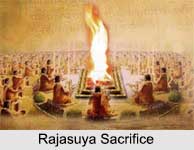
 Rajasuya Sacrifice is traditionally the Vedic rite that confers entire sovereignty. It is usually performed for the empire to be strong and for the king to get deliverance. Rajasuya Sacrifice is performed by the Maharaja Yudhi??hira after gaining the victory in the Battle of Kuruketra.
Myths of Rajasuya Sacrifice
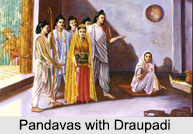
In the classical epic tradition, the ostensible completion of the Rajasuya is immediately followed by the humiliation of Duryodhana. The Pandavas` "sabha" was built for them with numerous illusionist intricacies by the demon (asura) Maya. Unlike Arjuna, who shoots the fish while looking at its reflection, Duryodhana is unable to penetrate the surface appearances of the sabha`s pools and polished walls.
Dharma`s pretensions to pre-eminence and his eventual "completion" of the ceremony are what rankles Duryodhana. In the drama, however, this traditional purpose is muted, and Dharma is told by the trouble-stirring Narada that he should perform the rite to elevate the Pandavas` father, Pandu, to the world of Indra. Dharma then confers with Draupadi, who tells him to consult with her elder brother, Krishna. Lord Krishna arrives and tells Dharma he can do the sacrifice, but not before disposing of Jarasandha. Krishna`s reasons vary. In the performed version, he says that Jarasandha`s riches will solve the problem of paying for the expensive rite. Another explanation of the Rajasuya sacrifice says that the price for the Rajasuya is obtained, at Krishna`s suggestion, by Arjuna`s killing of the underworld demon Patala Arakkan and his marriage to the demon`s daughter. In the more classical version, the expenses are met by the wealth obtained from the Pandavas` conquest of the four directions. In both versions, Krishna has a more fundamental reason for wanting to be rid of Jarasandha. Jarasandha has defeated him many times in battle.
It has been mentioned in the epics that it is Bhima once again who is finally called on to fight Jarasandha. After the elimination of Jarasandha and the return to Indraprastha, the Rajasuya soon begins. It took place in the "yakacalai" of the Pandavas` "sabha". The turning point is reached when Bhisma, the venerable Kaurava elder, announces that Krishna should be given the first offering of "tampulam". This acknowledges that Krishna is the, most honoured guest present. Dharma follows this advice, but Sisupala, king of Chedi, rises in fury. Moreover, he insults the Pandavas, questioning their father`s paternity and their common marriage to Draupadi. Finally Krishna takes up his chakra, makes a lamp and incense offering to it, and severs Sisupala`s head.